
What Is an Auto-Darkening Welding Helmet?
An auto-darkening welding helmet uses an electronic automatic darkening filter, commonly called an ADD, to change the lens from a relatively light state to a darker welding shade when the helmet detects an arc.
With a traditional passive welding helmet, the lens remains at a fixed dark shade. You have to lift the helmet to see the work piece and lower it before starting the weld.
An auto-darkening helmet works differently.
When there is no arc, the lens remains light enough for you to see the work piece, joint, tools, and surroundings. When the sensors detect the welding arc, the filter switches to its selected dark shade.
This means you can position the gun or electrode with the helmet already down.
That is especially useful for:
- Tack welding
- MIG welding
- TIGER welding
- Stick welding
- Fabrication
- Automotive repair
- Welding in awkward positions
- Repetitive production work
Modern helmets can also include grinding modes, adjustable sensitivity, delay controls, multiple sensors, variable shade adjustment, and enhanced-color or true-color optics.
Why an Auto-Darkening Helmet Is Better for Many Welders
The biggest advantage is convenience.
You don’t need to repeatedly raise and lower the helmet.
But there are several other benefits.
Better Visibility Before the Arc Starts
Because the lens remains relatively light before welding, you can see the joint while positioning the torch.
This can make tack welding and precise positioning easier.
Less Head Movement
With a passive helmet, welders often develop the habit of positioning the helmet before striking the arc.
An auto-darkening helmet allows you to keep the helmet in place.
Faster Tack Welding
For fabrication work involving many short welds, not having to repeatedly lift the hood can save time.
Better Workflow
An auto-darkening helmet lets you maintain a consistent working position.
This can be particularly useful when welding in awkward positions or around complicated assemblies.
Reduced Eye Strain
A good lens with appropriate shade selection and clear optics can make it easier to observe the weld without constantly fighting glare or excessive darkness.
However, the helmet still needs to be correctly selected and adjusted for the welding process.
What Makes the Best Auto-Darkening Welding Helmet?
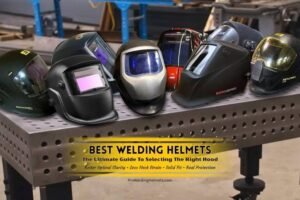
There is no single helmet that is perfect for every welder.
A professional TIGER welder may prioritize optical clarity and low-amperage sensitivity.
A construction welder may prioritize durability and impact protection.
A hobbyist may prioritize affordability and comfort.
An automotive fabricator may want a large viewing area and excellent color recognition.
The most important specifications include:
- Optical clarity
- Lens shade range
- Switching speed
- Number of sensors
- Viewing area
- True-color technology
- Sensitivity adjustment
- Delay adjustment
- Grind mode
- Weight
- Headgear quality
- Power source
- Battery life
- Lens protection
- Safety certification
Let’s examine each feature.
1. Optical Clarity
Optical clarity is one of the most important features of a welding helmet.
A helmet can have an extremely fast switching time, but if the lens makes the weld appear distorted or blurry, it may still be difficult to use.
Premium auto-darkening filters are often rated using the EN 379 optical classification system.
A rating such as:
1/1/1/1
represents the highest class across the four evaluated optical categories.
The four categories relate to optical quality, light diffusion, variation in luminous transmittance, and angular dependence.
Current welding-helmet comparisons commonly describe 1/1/1/1 as the benchmark for premium optical performance.
For a professional welder who spends many hours under a helmet, good optical clarity can be more valuable than chasing an extremely small difference in switching speed.
2. True-Color Lens Technology
Traditional welding lenses often give the welder a green or strongly tinted view.
Modern true-color technologies attempt to provide a more natural view of the work piece and weld puddle.
This can make it easier to distinguish:
- Weld puddle
- Base metal
- Filler metal
- Joint edges
- Slag
- Spatter
- Heat-affected areas
Current premium helmets from manufacturers such as Lincoln Electric, Miller, ES-AB, and 3M emphasize improved color perception or natural-color viewing. Recent 2026 comparisons also identify true-color performance as one of the most noticeable improvements over older helmet designs.
For TIGER welding in particular, being able to see subtle changes in the puddle can be extremely useful.
3. Reaction or Switching Speed
Switching speed refers to how quickly the lens changes from its light state to its dark welding state after detecting the arc.
Manufacturers often express it as something like:
1/20,000 second
or
1/25,000 second.
Modern helmets can advertise extremely fast switching speeds, but this specification should not be considered in isolation.
A helmet with excellent optics, reliable sensors, good low-amperage sensitivity, and consistent switching can be more useful than a helmet that simply advertises the fastest numerical reaction time.
Recent 2026 comparisons show that switching speeds vary considerably on paper, with premium and budget helmets both advertising very fast times.
The important thing is consistent performance under real welding conditions.
4. Number of Sensors
Most quality auto-darkening welding helmets use multiple arc sensors.
Four-sensor designs are particularly useful for welders who work in different positions.
Why?
Because part of the helmet or your body position can sometimes obstruct one or more sensors.
Multiple sensors increase the likelihood that the filter will detect the arc correctly.
Four-sensor configurations are common on many professional helmets, including current Lincoln and ES-AB models.
For normal bench welding, two sensors may be adequate on some helmets.
For professional welding, out-of-position work, and complex fabrication, four sensors can provide additional confidence.
5. Viewing Area
A larger viewing area can make a significant difference.
A large lens allows you to see more of:
- The joint
- The work piece
- The torch
- The weld puddle
- Surrounding components
This can be especially useful when working on large assemblies.
However, a larger viewing area can increase helmet size and weight.
You should balance visibility with comfort.
Some current professional helmets offer viewing areas around 12 square inches or more, while other compact helmets use smaller windows. Recent comparisons list approximately 12.5 square inches for the Lincoln Viking 3350 and larger or smaller windows across competing designs.
6. Shade Range
Shade range determines how dark the lens can become and which welding processes it can accommodate.
Many auto-darkening welding helmets provide a dark-state range such as:
Shade 9–13
Other models offer broader ranges, including lighter settings useful for plasma cutting or other applications.
For example, the Lincoln Viking 1840 is currently listed with a shade range extending from 5–13, which makes it more versatile for users who also perform plasma cutting.
Don’t assume that a wider shade range automatically makes a helmet better.
Choose a range that matches your actual processes.
7. TIGER Sensitivity
TIGER welding can involve relatively low amperage, especially when welding thin materials.
That means the helmet must be sensitive enough to detect the arc reliably.
A helmet that works perfectly with a high-amperage MIG arc may not perform equally well with very low-amperage TIGER.
If TIGER welding is a major part of your work, look for:
- Adjustable sensitivity
- Reliable low-amperage detection
- Multiple sensors
- Good optical clarity
- Suitable light-state visibility
Professional TIGER welders should pay particular attention to this feature.
8. Sensitivity Adjustment
Sensitivity controls how easily the helmet’s sensors react to light.
If sensitivity is too low, the helmet may fail to react reliably to a weak arc.
If it is too high, it may react to nearby welding arcs or bright light sources.
Adjustable sensitivity is therefore useful in environments where multiple welding stations are operating.
9. Delay Adjustment
Delay determines how long the lens remains dark after the arc stops.
A short delay can be useful for quick tack welds.
A longer delay can be useful when the metal remains extremely bright immediately after welding.
Having an adjustable delay gives you more control.
10. Grind Mode
A grind mode is an extremely useful feature.
In grind mode, the automatic darkening function is disabled or configured so that the lens remains at a light shade suitable for grinding.
This means you can use one helmet for:
- MIG welding
- TIGER welding
- Stick welding
- Grinding
- Some cutting operations, when the helmet is specifically rated and configured for them
However, grind mode does not mean the helmet provides welding-shade protection while grinding. Always use the appropriate eye and face protection for the grinding operation.
Best Auto-Darkening Welding Helmet for Professionals
For professional welders, optical performance, comfort, durability, and reliability should generally take priority over price.
Several premium helmet families are worth comparing.
Lincoln Electric Viking Series
Lincoln Electrics Viking line is widely recognized for advanced optical performance and large viewing areas.
The Viking 3350, for example, is commonly highlighted for its 4C lens technology, large viewing area, multiple sensors, and high optical classification. Recent 2026 comparisons list it among the leading professional auto-darkening helmets.
The Viking 1840 is another current option with a broad 5–13 shade range and 1/1/1/1 optical classification.
Best for
- Professional fabrication
- MIG welding
- TIGER welding
- Stick welding
- Multi-process users
- Welders who value optical clarity
Miller Digital Welding Helmets
Miller offers several premium welding helmets designed around clear viewing, comfort, and advanced lens technology.
Miller helmets are especially popular among professional welders who spend long periods under a hood.
A premium Miller helmet can make sense when comfort and optical performance are more important than minimizing purchase price.
Best for
- Professional welders
- TIGER users
- Long welding sessions
- Fabrication shops
- Users who want premium headgear
ES-AB Sentinel Series
The ES-AB Sentinel family has a distinctive shell design and is known for its broad viewing area and advanced lens/headgear system.
Recent comparisons continue to list the Sentinel A50 among premium auto-darkening helmets, particularly for users who value optical clarity, ergonomics, and external adjustment.
Best for
- Professional fabrication
- Multi-process welding
- Long work sessions
- Users who prefer advanced headgear
- Welders who want easy external adjustments
3M Speedwell
3M Speedwell is another established name in professional welding protection.
The Speedwell range is particularly well known in industrial and professional environments.
Current 2026 comparisons continue to position models such as the Speedwell 9100XXi toward production-shop users who prioritize natural-color optics, low-amperage TIGER performance, and premium headgear.
Best for
- Production welding
- Professional TIGER
- Industrial environments
- Long-duration use
- Premium protection systems
Best Auto-Darkening Welding Helmet for Beginners
Beginners don’t necessarily need the most expensive helmet.
However, buying an extremely cheap helmet solely because it has an auto-darkening function may not be the best strategy.
A beginner should look for:
- Reliable arc detection
- Good optical clarity
- Adjustable shade
- Adjustable sensitivity
- Grind mode
- Comfortable headgear
- Adequate viewing area
- Recognized safety certification
The helmet should make learning easier rather than introducing unnecessary visibility problems.
For someone learning MIG welding in a garage, a good mid-range helmet with a clear lens can be a better investment than an entry-level helmet with poor optics.
Best Auto-Darkening Helmet for MIG Welding
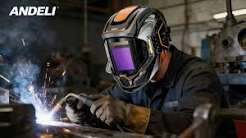
MIG welding typically produces a relatively bright arc and can generate substantial spatter.
A good MIG helmet should have:
- Appropriate shade range
- Good side visibility
- Large viewing area
- Multiple sensors
- Fast and reliable switching
- Durable outer shell
- Replaceable cover lenses
If you weld frequently, prioritize comfort.
MIG fabrication can involve many short welds, meaning your head may remain under the helmet for extended periods.
Best Auto-Darkening Helmet for TIGER Welding
TIGER welders have different requirements.
TIGER often requires you to closely observe the weld puddle and filler material.
For that reason, TIGER users should prioritize:
- Optical clarity
- True-color viewing
- Low-amperage sensitivity
- Multiple sensors
- Good light-state visibility
- Comfortable headgear
- Appropriate shade adjustment
If you’re welding thin stainless steel or aluminum, the ability to clearly see the puddle can be extremely valuable.
Best Auto-Darkening Helmet for Stick Welding
Stick welding produces intense light, sparks, and spatter.
A durable shell and appropriate shade range are important.
For outdoor work, durability and comfort may be more important than having the largest viewing area.
Stick welders should also ensure that the selected dark shade is appropriate for the welding current and electrode.
OSHA guidance emphasizes selecting welding filter shades according to the welding process and current, and recommends using the darkest shade that still allows adequate task performance.
Best Auto-Darkening Helmet for Plasma Cutting
Not every welding helmet is ideal for plasma cutting.
If you use a helmet for plasma cutting, check its specified shade range and manufacturer-approved applications.
A helmet with a lighter adjustable shade range can be useful.
For example, current listings for the Lincoln Viking 1840 highlight its 5–13 range as an advantage for users who also perform plasma cutting.
Always follow the plasma cutter manufacturer’s recommended eye-protection requirements.
How Dark Should a Welding Helmet Be?

There is no single shade setting that works for every welding process.
The correct shade depends on:
- Welding process
- Amperage
- Electrode size
- Material
- Welding position
- Applicable safety guidance
OSHA notes that filter shade selection should be based on the process and arc current, and recommends selecting the darkest shade that permits adequate task performance.
As a general concept, many common MIG and stick applications fall around shades 10–13, while lower-amperage TIGER can use lighter shades.
However, always follow the helmet manufacturer’s instructions and applicable welding-safety standards rather than relying on a generic internet chart.
What Does 1/1/1/1 Mean on a Welding Helmet?
The 1/1/1/1 rating comes from the EN 379 optical classification system.
It indicates top-level performance in four optical categories.
The four values relate to:
- Optical clarity
- Diffusion of light
- Variation in luminous transmittance
- Angular dependence
Lower numbers represent better performance.
Therefore:
1/1/1/1 = highest class in all four categories.
Many premium helmets now advertise 1/1/1/1 optical performance.
However, don’t use optical rating as the only buying criterion.
Comfort, sensor performance, shade control, viewing area, and headgear also matter.
Is Faster Switching Always Better?
Not necessarily.
Switching speed is important, but the difference between extremely fast modern helmets may not be as important as other features.
For example, a helmet that switches in 1/25,000 second and another that switches in 1/20,000 second are both extremely fast.
Other differences may matter more in actual use:
- Optical clarity
- Sensor reliability
- Low-amperage TIGER response
- Color perception
- Comfort
- Viewing area
- Headgear
Recent 2026 comparisons show that some inexpensive helmets advertise extremely fast switching times, demonstrating why switching speed should not be used as the sole measure of helmet quality.
Solar-Powered vs Battery-Powered Helmets
Many auto-darkening helmets use a combination of solar cells and batteries.
Solar power can help extend battery life.
Some helmets use replaceable batteries.
Others may use rechargeable systems.
When comparing helmets, check:
- Battery type
- Battery replacement procedure
- Expected battery life
- Low-battery indicator
- Auto-on/off function
A helmet that becomes inconvenient to power can become frustrating over time.
Helmet Weight Matters More Than You Think
A welding helmet may feel comfortable for five minutes and uncomfortable after three hours.
Weight affects:
- Neck fatigue
- Head movement
- Balance
- Overall comfort
A lighter helmet isn’t automatically better.
The center of gravity and headgear design matter just as much.
A well-balanced helmet can feel more comfortable than a lighter helmet with poor weight distribution.
For professional welders, headgear quality can be one of the most important long-term considerations.
Headgear and Adjustment System
The lens gets most of the attention, but the headgear determines how the helmet actually feels.
Look for:
- Multiple adjustment points
- Comfortable forehead padding
- Secure fit
- Easy ratchet adjustment
- Good balance
- Adequate range of adjustment
The helmet should remain stable when you move your head.
It should not constantly shift forward or backward.
Replaceable Cover Lenses
The outer lens protects the expensive auto-darkening filter from:
- Spatter
- Scratches
- Dust
- Grinding debris
- Smoke deposits
This cover lens will eventually become dirty or damaged.
Make sure replacement lenses are available and reasonably priced.
A helmet with easily available replacement cover lenses can be more economical over its lifetime.
Safety Standards and Certification
Safety certification is critical.
In the United States, look for appropriate compliance markings such as ANSI Z87.1 where applicable.
ANSI standards cover requirements for eye and face protection, including automatic darkening welding filters.
The automatic filter must meet specified requirements for UV and infrared transmittance, switching behavior, and other performance characteristics.
A helmet should not be selected purely because it has an attractive design or impressive marketing specifications.
Check the actual certification and manufacturer documentation.
Can a Cheap Auto-Darkening Welding Helmet Be Safe?
Price alone does not determine safety.
Some budget helmets can offer useful features at a low price.
However, the buyer should verify:
- Genuine safety certification
- Reliable manufacturer information
- Lens specifications
- Replacement lenses
- Warranty
- Sensor performance
- Correct shade range
The real concern is not simply whether a cheap helmet darkens.
You also want predictable performance, good optical quality, reliable switching, adequate impact protection, and dependable long-term operation.
For a person who welds every day, spending more on a professional helmet can be justified.
For occasional DAY welding, a compliant mid-range helmet may offer excellent value.
Common Mistakes When Buying a Welding Helmet
Mistake 1: Choosing Only by Price
The cheapest helmet isn’t necessarily the best value.
A helmet that causes eye strain or makes it difficult to see the weld can negatively affect your work.
Mistake 2: Looking Only at Switching Speed
Fast switching is useful, but optics and reliability matter too.
Mistake 3: Ignoring Comfort
A helmet that hurts your neck after an hour isn’t a good professional tool.
Mistake 4: Choosing the Wrong Shade Range
Make sure the helmet supports your welding processes.
Mistake 5: Ignoring TIGER Requirements
Low-amperage TIGER requires reliable sensor sensitivity.
Mistake 6: Forgetting Replacement Lenses
Cover lenses eventually become scratched and dirty.
Mistake 7: Assuming Every Auto-Darkening Lens Is the Same
Lens technology varies significantly between manufacturers and models.
How to Test an Auto-Darkening Welding Helmet
Before using a new helmet on an important project, inspect it carefully.
Check:
- Lens condition
- Outer cover lens
- Headgear
- Battery
- Shade controls
- Sensitivity controls
- Delay controls
- Grind mode
- Manufacturer markings
- Certification information
Then perform a controlled test according to the manufacturer’s instructions.
Do not stare directly at a welding arc to “test” the helmet.
The helmet should be used according to its operating instructions and the appropriate welding-safety procedures.
How to Maintain an Auto-Darkening Welding Helmet
Proper maintenance extends helmet life.
Clean the Outside
Use the manufacturer’s recommended cleaning method.
Avoid harsh chemicals that could damage the lens or shell.
Replace Cover Lenses
Replace scratched or heavily contaminated cover lenses.
Inspect the Filter
If the auto-darkening filter becomes cracked, damaged, or behaves abnormally, stop using the helmet and follow the manufacturer’s replacement/service instructions.
Check Headgear
Inspect adjustment mechanisms and padding.
Protect the Helmet
Store it in a clean, dry location away from unnecessary impact and extreme conditions.
Replace Batteries
Follow the manufacturer’s battery recommendations.
Auto-Darkening Helmet vs Passive Welding Helmet
A passive helmet uses a fixed dark filter.
An auto-darkening helmet changes its shade electronically.
Passive Helmet Advantages
- Simple
- Inexpensive
- No electronic components
- No battery
- Extremely durable designs are available
Passive Helmet Disadvantages
- Difficult to see before welding
- Requires repeated hood movement
- Less convenient for tack welding
- Can make positioning harder
Auto-Darkening Helmet Advantages
- Automatic shade adjustment
- Better ore-weld visibility
- Convenient
- Excellent for repeated tack welding
- Useful for multi-process welding
Auto-Darkening Helmet Disadvantages
- More expensive
- Requires batteries or another power source
- Electronics can fail
- Requires more maintenance
For most modern hobby and professional welders, a good auto-darkening helmet is the more convenient choice.
What Is the Best Auto-Darkening Welding Helmet Overall?
There isn’t a universal winner, but several helmet categories stand out.
Best Overall Professional Choice
Lincoln Electric Viking 3350
It is a strong choice for welders who prioritize a large viewing area, advanced optics, true-color viewing, and professional-level performance. Recent 2026 comparisons continue to place the Viking 3350 among the leading premium helmets.
Best for Broad Process Coverage
Lincoln Electric Viking 1840
Its 5–13 shade range, 1/1/1/1 optical classification, four sensors, and grind mode make it particularly interesting for users who perform multiple processes, including plasma cutting.
Best Premium Industrial Category
3M Speedwell 9100XXi
This type of helmet is aimed at users who weld frequently and place a high priority on optical performance, low-amperage TIGER response, and professional headgear.
Best Alternative Professional Choice
ES-AB Sentinel A50
The Sentinel A50 remains a popular premium option for users who want a large viewing area, advanced optics, and distinctive ergonomic headgear.
Best Budget Approach
For occasional hobby welding, there are numerous lower-cost auto-darkening helmets offering true-color lenses, multiple sensors, and fast switching specifications. However, verify actual safety certification and manufacturer documentation before purchasing rather than selecting purely by price or advertised switching speed.
Final Buying Checklist
Before buying an auto-darkening welding helmet, check the following:
- Appropriate safety certification
- Correct shade range
- Good optical clarity
- Reliable arc sensors
- Suitable TIGER sensitivity
- Large enough viewing area
- Comfortable headgear
- Adjustable shade
- Adjustable sensitivity
- Adjustable delay
- Grind mode
- Replaceable outer cover lens
- Available replacement parts
- Suitable battery system
- Reasonable weight
- Good warranty
- Reputable manufacturer
Final Verdict
The best auto darkening welding helmet should give you three things above all else: reliable protection, clear vision, and comfortable long-term use.
For professional welders, premium models such as the Lincoln Electric Viking 3350, Lincoln Viking 1840, Miller’s professional Digital helmet range, ES-AB Sentinel series, and 3M Speedwell are worth comparing because they combine advanced optical systems with professional-grade features. Current 2026 comparisons continue to highlight these brands for optical clarity, true-color viewing, sensor performance, comfort, and process versatility.
For beginners and occasional DAY users, you don’t necessarily need to spend several hundred dollars. A properly certified mid-range helmet with good optics, reliable sensors, adjustable shade, and comfortable headgear can provide excellent value.
If you’re primarily a MIG welder, prioritize viewing area, durability, and comfortable headgear.
If you’re a TIGER welder, prioritize optical clarity, true-color viewing, and low-amperage sensitivity.
If you primarily stick weld, focus on appropriate shade range, durability, and reliable switching.
If you work with plasma cutting, make sure the helmet specifically supports the required shade range and application.
And if you’re a professional multi-process welder, consider investing in a premium helmet with 1/1/1/1 optical performance, multiple sensors, excellent headgear, a broad shade range, and readily available replacement lenses.
Most importantly, don’t choose a helmet simply because its marketing claims the fastest switching speed or largest viewing area. Look at the complete package: optical clarity, shade performance, sensor reliability, comfort, certification, durability, and manufacturer support.
A good auto-darkening welding helmet is an investment you use on virtually every welding job. Spending a little more for clear optics, dependable performance, and comfortable headgear can pay off every time you put the hood down.
For anyone building a serious welding setup, the helmet should be treated as essential protective equipment—not an accessory to purchase at the lowest possible price.
For More Information about this a rtical Click Here
For More Information about this Click Here