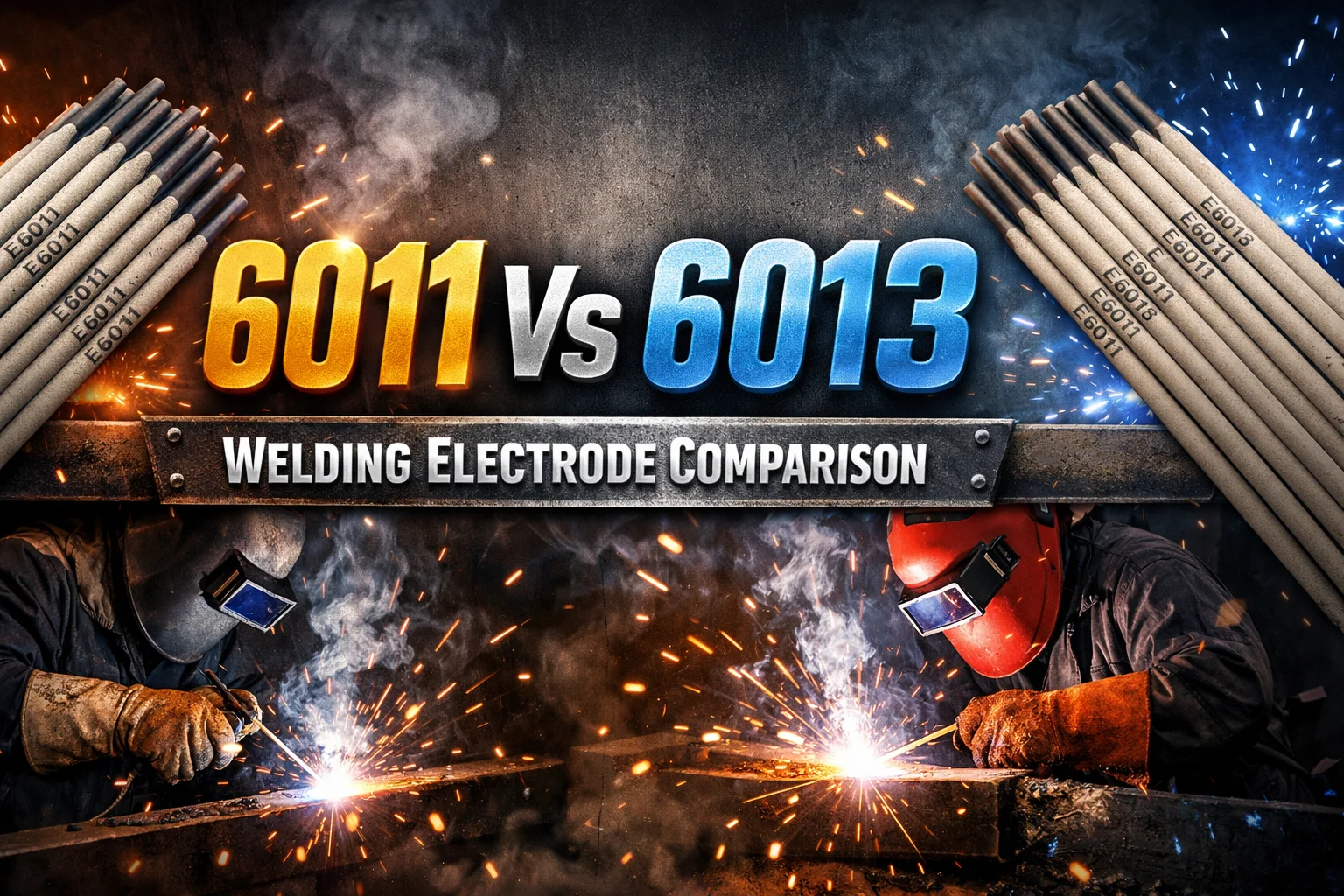
At first glance, these rods may look similar. They are all used for stick welding and can weld steel, but they behave very differently.
One rod is excellent for penetrating dirty and rusty metal. Another is easier for beginners and produces smooth-looking welds. The third is widely used when strong, high-quality welds are required.
So, which welding rod should you use?
The answer depends on several factors, including:
- The condition of the metal
- The thickness of the material
- The required weld strength
- Your welding machine
- AC or DC power
- The welding position
- Whether appearance or penetration is more important
In this complete guide, we compare 6011 vs 6013 vs 7018 welding rods in detail. You will learn their differences, strengths, weaknesses, applications, and how to choose the right electrode for your project.
Table of Contents
- Understanding Welding Rod Numbers
- 6011 Welding Rod Overview
- 6013 Welding Rod Overview
- 7018 Welding Rod Overview
- 6011 vs 6013 vs 7018: Quick Comparison
- Strength Comparison
- Penetration Comparison
- Ease of Use
- AC vs DC Compatibility
- Best Rod for Dirty Metal
- Best Rod for Beginners
- Best Rod for Structural Welding
- Best Rod for Farm Repairs
- Best Rod for Thin Metal
- Best Rod for Thick Metal
- Welding Positions
- Slag Comparison
- Weld Appearance
- Storage Requirements
- Common Problems With Each Rod
- How to Choose the Right Welding Rod
- Frequently Asked Questions
- Final Thoughts
Understanding Welding Rod Numbers
Before comparing these electrodes, it helps to understand what the numbers on a welding rod mean.
For example:
E6011
The letter E stands for electrode.
The first two digits generally indicate the minimum tensile strength of the deposited weld metal.
Therefore:
- 60 means approximately 60,000 PSI tensile strength.
- 70 means approximately 70,000 PSI tensile strength.
The third digit indicates the welding positions the electrode is designed for.
A 1 generally means the rod can be used in multiple welding positions, including:
- Flat
- Horizontal
- Vertical
- Overhead
The final digit provides information about the electrode coating and the recommended current characteristics.
This is why understanding the electrode classification helps you choose the correct rod instead of simply selecting the one that is most popular.
What Is a 6011 Welding Rod?
The E6011 welding rod is a versatile stick welding electrode known for its strong penetration and ability to weld through contaminated surfaces.
It is especially popular for repair work.
Unlike some electrodes that require extremely clean metal, the 6011 can perform relatively well when the surface contains:
- Rust
- Dirt
- Paint
- Light contamination
This does not mean you should never clean the metal. Proper preparation is always recommended. However, the 6011 is more forgiving than many other electrodes.
Main Characteristics of 6011
The 6011 electrode is known for:
- Deep penetration
- Fast-freezing weld puddle
- Good performance on dirty steel
- All-position welding capability
- Strong arc action
- Excellent performance for repair work
Because of its penetrating characteristics, the 6011 is commonly used when welders need to reach deeper into the base metal.
Advantages of 6011 Welding Rods
1. Excellent Penetration
One of the biggest advantages of the 6011 rod is penetration.
It can penetrate deeper into steel than a smoother, lower-penetration electrode such as a typical 6013.
This makes it useful for:
- Repairs
- Root passes
- Rusty steel
- Dirty metal
- Field work
2. Good for Dirty Metal
The 6011 is commonly chosen for steel that is not perfectly clean.
For example, farm equipment or old machinery may have rust and surface contamination.
A 6011 electrode can often handle these conditions better than rods that require cleaner surfaces.
3. All-Position Capability
The electrode can be used in different welding positions.
This makes it useful when working on equipment where you cannot easily move the part into a flat position.
4. Useful for Repair Work
Many welders keep 6011 rods available for repair jobs.
Its penetration and aggressive arc make it useful for repairing:
- Farm machinery
- Metal equipment
- Gates
- Trailers
- Old steel structures
Disadvantages of 6011 Welding Rods
Despite its advantages, the 6011 also has some limitations.
1. Rougher Weld Appearance
The weld may not look as smooth or attractive as a weld made with a 6013 or 7018.
If appearance is extremely important, another electrode may be a better choice.
2. More Difficult for Some Beginners
The aggressive arc can be more challenging for inexperienced welders.
A beginner may find the welding puddle harder to control.
3. More Cleanup
The finished weld may require additional cleanup depending on the application.
What Is a 6013 Welding Rod?
The E6013 welding rod is one of the most popular electrodes for beginners and general-purpose welding.
It is known for producing a smoother and more visually attractive weld bead.
Compared with the 6011, the 6013 generally provides less aggressive penetration but easier puddle control.
This makes it useful for many general welding projects.
Main Characteristics of 6013 Welding Rods
The 6013 is commonly known for:
- Smooth arc
- Easy operation
- Attractive weld appearance
- Moderate penetration
- Good performance on clean steel
- General-purpose applications
It is frequently used for:
- Home projects
- Light fabrication
- Metal furniture
- Gates
- Hobby welding
- General repairs
Advantages of 6013 Welding Rods
1. Beginner-Friendly
The 6013 is often considered easier for beginners.
The arc is generally smoother and easier to control compared with the more aggressive 6011.
This allows new welders to focus on:
- Travel speed
- Electrode angle
- Arc length
- Weld puddle control
2. Smooth Weld Appearance
The 6013 can produce visually attractive weld beads.
This makes it useful for projects where appearance matters.
For example:
- Decorative metalwork
- Furniture
- Gates
- Light fabrication
3. Easier Slag Removal
The slag produced by a 6013 is often easier to manage compared with some other electrodes.
This can make cleanup simpler.
Disadvantages of 6013 Welding Rods
1. Less Penetration
Compared with the 6011, the 6013 generally does not provide the same aggressive penetration.
This can make it less suitable for heavily contaminated material or applications requiring deep penetration.
2. Requires Better Surface Preparation
For the best results, the base metal should be relatively clean.
Rust, heavy paint, oil, and contamination can negatively affect weld quality.
What Is a 7018 Welding Rod?
The E7018 welding rod is one of the most important electrodes used for high-quality steel welding.
It is widely known for producing strong, reliable welds.
The 7018 is commonly used in applications where weld quality and mechanical properties are extremely important.
It is often associated with:
- Structural welding
- Heavy fabrication
- Construction
- Industrial projects
- Professional welding
Main Characteristics of 7018 Welding Rods
The 7018 electrode is known for:
- Approximately 70,000 PSI minimum tensile strength classification
- Smooth welding characteristics
- High-quality weld deposits
- Good mechanical properties
- Low-hydrogen characteristics
- Attractive weld appearance
Advantages of 7018 Welding Rods
1. Strong Welds
The biggest advantage of the 7018 is its strength classification.
It is commonly selected for projects where a strong weld is required.
This makes it popular for:
- Structural steel
- Heavy equipment
- Construction
- Fabrication
2. Smooth Weld Appearance
The 7018 can produce smooth and professional-looking weld beads.
With proper technique, the finished weld can have an attractive appearance.
3. High-Quality Weld Deposits
The 7018 is valued for producing quality welds when used correctly.
This is one reason it is popular in professional welding environments.
Disadvantages of 7018 Welding Rods
1. Requires Proper Storage
One of the most important considerations with 7018 electrodes is storage.
Because it is a low-hydrogen electrode, moisture control can be important for maintaining the intended properties.
Rods should be stored according to manufacturer recommendations.
2. Requires Cleaner Metal
Although some surface contamination may be tolerated depending on conditions, the best results require properly cleaned and prepared metal.
3. May Be Less Forgiving for Beginners
While the arc can be smooth, beginners must learn proper technique and equipment settings.
6011 vs 6013 vs 7018: Quick Comparison
| Feature | 6011 | 6013 | 7018 |
|---|---|---|---|
| Tensile Strength Classification | 60,000 PSI | 60,000 PSI | 70,000 PSI |
| Penetration | Deep | Moderate | Moderate to good |
| Beginner Friendly | Moderate | Excellent | Moderate |
| Dirty Metal | Excellent | Poor to moderate | Better on clean metal |
| Weld Appearance | Rougher | Smooth | Smooth |
| Structural Work | Limited depending on requirements | General light work | Excellent for appropriate applications |
| Repair Work | Excellent | Good | Good |
| Surface Preparation | More forgiving | Important | Important |
| Storage Sensitivity | Standard care | Standard care | Requires moisture control |
This table provides a quick overview, but choosing the correct rod depends on the specific project.
6011 vs 6013 vs 7018: Strength Comparison
The 6011 and 6013 classifications indicate approximately 60,000 PSI minimum tensile strength.
The 7018 classification indicates approximately 70,000 PSI minimum tensile strength.
Therefore, based on classification:
7018 has the higher tensile strength rating.
However, welding strength is not determined by the rod alone.
A strong weld also requires:
- Proper joint preparation
- Correct welding technique
- Proper machine settings
- Good penetration
- Adequate fusion
- Suitable base metal
A poorly made 7018 weld can still fail.
Likewise, a properly executed 6011 weld can be extremely effective for the applications it is designed for.
Penetration Comparison
Penetration is one of the biggest differences between these electrodes.
6011: Deep Penetration
The 6011 is the best choice among these three when strong penetration is required on less-than-perfect surfaces.
Its aggressive arc helps penetrate into the material.
6013: Moderate Penetration
The 6013 provides more moderate penetration.
It is better suited for clean steel and general-purpose work.
7018: Controlled Penetration
The 7018 provides good fusion and weld quality when proper procedures are followed.
It is commonly selected for stronger structural and fabrication applications.
Winner for Penetration:
6011
Which Welding Rod Is Best for Beginners?
For most beginners:
Winner: 6013
The 6013 is generally the easiest choice because it provides:
- Smooth arc characteristics
- Easier puddle control
- Attractive welds
- General-purpose capability
A beginner learning stick welding can benefit from practicing with 6013 rods on clean steel.
However, beginners should eventually learn to use 6011 and 7018 as well.
Each rod teaches different skills.
Which Rod Is Best for Dirty or Rusty Metal?
Winner: 6011
The 6011 is commonly preferred for repair work involving less-than-perfect metal surfaces.
It is particularly useful when working with:
- Old machinery
- Farm equipment
- Rusty steel
- Field repairs
However, removing heavy rust, paint, and contamination is still recommended whenever possible.
Which Welding Rod Is Best for Structural Welding?
Winner: 7018
For appropriate structural applications, the 7018 is commonly preferred because of its strength classification and weld characteristics.
However, structural welding may involve specific requirements, codes, procedures, and qualified welders.
Never assume that simply using a 7018 rod automatically makes a weld suitable for structural applications.
Proper welding procedures matter.
Best Welding Rod for Farm Repairs
Farm repairs can involve dirty, rusty, and older steel.
For these situations:
Best Choice: 6011
The 6011 is often extremely useful for repair work because of its penetrating arc.
For certain repairs, welders may use multiple electrodes.
For example, one electrode may be useful for penetration while another is selected for finishing or filling.
The correct approach depends on the application.
Best Welding Rod for Thin Metal
Thin metal can be challenging because excessive heat can cause:
- Burn-through
- Warping
- Distortion
The 6013 is often easier to control for lighter fabrication projects.
However, the correct electrode diameter and welding settings are equally important.
Using a rod that is too large for thin material can create excessive heat.
Best General Choice for Thin, Clean Steel:
6013
Best Welding Rod for Thick Metal
Thicker metal requires proper penetration and joint preparation.
The best electrode depends on the application.
A 6011 can provide strong penetration.
A 7018 can be useful for high-quality filling and strong weld deposits.
For thicker material, welders may use:
- Beveled joints
- Multiple passes
- Different electrodes for different passes
Professional welding procedures should be followed when weld integrity is critical.
AC vs DC: Which Rod Works Best?
The type of welding machine you own can affect your electrode choice.
Some electrodes perform differently depending on whether you are using:
- AC current
- DC electrode positive
- DC electrode negative
Always check the electrode manufacturer’s specifications.
6011
The 6011 is commonly associated with AC and DC capabilities depending on the specific electrode.
It is popular with many traditional stick welding machines.
6013
The 6013 is commonly used with AC and DC machines.
This versatility contributes to its popularity among beginners.
7018
Different versions of 7018 electrodes may have different current compatibility.
Always check the packaging and manufacturer recommendations.
Never assume every electrode performs identically across all machines.
Welding Positions
All three rods are commonly associated with all-position classifications when designated with the appropriate classification.
However, actual welding difficulty depends on:
- Rod diameter
- Welding technique
- Amperage
- Joint design
Vertical and overhead welding require additional skill.
A fast-freezing puddle can be helpful when welding outside the flat position.
Slag Comparison
Slag is the protective layer that forms over many stick welds.
After the weld cools, the slag must usually be removed.
6011 Slag
The 6011 typically produces slag that can be thinner and different in appearance compared with other electrodes.
Proper cleanup is still necessary.
6013 Slag
The 6013 often produces slag that many beginners find relatively easy to remove.
7018 Slag
The 7018 produces slag that protects the weld as it cools.
Proper slag removal between welding passes is extremely important.
If slag remains between passes, it can create defects.
Weld Appearance Comparison
If visual appearance is important, the rods can produce noticeably different results.
6011
Usually produces a rougher-looking weld.
Its appearance is often less important than its penetration and repair capabilities.
6013
Often produces smooth and visually attractive beads.
Excellent for projects where appearance matters.
7018
Can produce very professional-looking welds with proper technique.
Best Appearance:
6013 and 7018
Storage Requirements
Storage is an important part of electrode performance.
6011 Storage
Store rods in a dry location.
Avoid unnecessary exposure to moisture.
6013 Storage
Keep electrodes dry and protected from contamination.
7018 Storage
The 7018 requires special attention because moisture control can be important.
Follow the manufacturer’s storage and reconditioning recommendations.
For professional or code-sensitive welding, electrode handling procedures may be especially important.
Common Problems When Using 6011
Problem: Excessive Spatter
Possible causes include:
- Incorrect amperage
- Long arc length
- Poor technique
Solution
Adjust your amperage and maintain a consistent arc length.
Problem: Rough Weld Appearance
The 6011 naturally produces a more aggressive weld appearance.
Solution
Practice travel speed and electrode manipulation.
Problem: Electrode Sticking
Possible causes:
- Amperage too low
- Arc length too short
- Poor striking technique
Solution
Increase amperage gradually and practice starting the arc.
Common Problems When Using 6013
Problem: Poor Penetration
Possible causes:
- Low amperage
- Fast travel speed
- Thick material
Solution
Adjust the settings and make sure the rod is suitable for the material thickness.
Problem: Slag Inclusion
Possible causes:
- Poor cleaning between passes
- Incorrect technique
Solution
Remove all slag before making another welding pass.
Common Problems When Using 7018
Problem: Porosity
Possible causes include:
- Moisture contamination
- Dirty base metal
- Poor technique
Solution
Check electrode storage and clean the base metal.
Problem: Difficult Arc Starting
Some welders experience difficulty starting certain 7018 electrodes.
Solution
Practice proper arc starting techniques and use the recommended amperage range.
Problem: Slag Inclusion
This can happen when slag is not properly removed between passes.
Solution
Clean every weld pass thoroughly before continuing.
How to Choose Between 6011, 6013, and 7018
The easiest way to choose the correct rod is to evaluate your project.
Ask yourself these questions.
Is the Metal Dirty or Rusty?
Choose:
6011
The aggressive penetrating characteristics make it useful for repair work.
Is the Metal Clean and Appearance Important?
Choose:
6013
It is beginner-friendly and can produce smooth welds.
Do You Need Higher Strength and High-Quality Weld Characteristics?
Choose:
7018
For appropriate applications, the 7018 is commonly selected for strong, quality welds.
Real-World Examples
Example 1: Repairing a Rusty Farm Gate
The metal is old and may contain rust.
Best Choice:
6011
The electrode’s penetration makes it useful for repair work.
Example 2: Building a Metal Table
The steel is clean and appearance matters.
Best Choice:
6013
The smoother weld appearance makes it a good choice for general fabrication.
Example 3: Heavy Steel Fabrication
The project requires strong welds and proper quality control.
Best Choice:
7018
When used according to proper procedures, it is a popular choice for high-quality fabrication work.
Can You Use Multiple Rods on the Same Project?
Yes, depending on the welding procedure and application.
Some welders may use one electrode for:
- Root passes
- Penetration
And another for:
- Filling
- Finishing
However, the correct combination depends on the base material and welding requirements.
For critical projects, follow approved welding procedures.
Important Welding Technique Tips
No matter which electrode you use, proper technique is essential.
1. Maintain Correct Arc Length
An arc that is too long can cause:
- Spatter
- Poor weld quality
- Unstable arc
An arc that is too short can cause the electrode to stick.
2. Use the Correct Amperage
Too much amperage can cause:
- Excessive spatter
- Undercut
- Excessive heat
Too little amperage can cause:
- Poor penetration
- Electrode sticking
- Weak welds
3. Clean the Metal
Even if using a 6011, cleaning the metal usually improves weld quality.
Remove:
- Rust
- Paint
- Oil
- Grease
4. Watch the Weld Puddle
The weld puddle provides important information.
Pay attention to:
- Width
- Movement
- Fusion
- Cooling
Learning to read the puddle is one of the most important stick welding skills.
6011 vs 6013 vs 7018: Final Comparison
Choose 6011 When:
- Metal is rusty
- Metal is dirty
- Deep penetration is required
- You are performing repair work
- You need aggressive arc action
Best For:
Repairs, farm equipment, old steel, and dirty metal.
Choose 6013 When:
- You are a beginner
- Metal is relatively clean
- Appearance matters
- You are doing general fabrication
- You want a smoother welding experience
Best For:
Beginners, home projects, furniture, and light fabrication.
Choose 7018 When:
- Strong welds are required
- High-quality weld characteristics are important
- You are performing heavy fabrication
- The project requires appropriate structural welding procedures
Best For:
Heavy fabrication, professional projects, and applications requiring stronger weld deposits.
Frequently Asked Questions
Is 6011 Stronger Than 6013?
Both classifications indicate approximately 60,000 PSI minimum tensile strength.
However, they have different penetration and welding characteristics.
The 6011 generally provides more aggressive penetration.
Is 7018 Stronger Than 6011?
Based on the classification, the 7018 has a higher minimum tensile strength rating of approximately 70,000 PSI compared with approximately 60,000 PSI for the 6011.
However, actual weld performance depends on many factors.
Which Rod Is Easier for Beginners?
For most beginners:
6013
It generally offers easier puddle control and smoother weld characteristics.
Can I Weld Rusty Metal With 7018?
For the best weld quality, steel should be properly cleaned.
The 7018 is generally better suited to properly prepared surfaces than heavily contaminated metal.
Which Rod Has the Deepest Penetration?
Among these three:
6011
It is known for its aggressive penetrating characteristics.
Can I Use 6013 for Structural Welding?
Structural welding requirements depend on the applicable code, material, design, and welding procedure.
Do not select an electrode for critical structural work based only on general popularity.
Why Does My 7018 Rod Keep Sticking?
Possible reasons include:
- Low amperage
- Incorrect arc starting technique
- Improper machine settings
Check the manufacturer’s recommended operating range.
Can I Use 6011 and 7018 Together?
Depending on the welding procedure, different electrodes may be used for different passes.
However, critical welding projects should follow an appropriate welding procedure specification.
Final Thoughts: 6011 vs 6013 vs 7018
There is no single welding rod that is best for every project.
Each electrode has its own strengths.
The 6011 welding rod is excellent when you need strong penetration and are working with dirty or rusty steel.
The 6013 welding rod is an excellent choice for beginners, general-purpose welding, and projects where a smooth appearance is important.
The 7018 welding rod is widely respected for its higher strength classification, high-quality weld characteristics, and suitability for many demanding fabrication applications.
The simplest way to remember the difference is:
🔥 6011 = Penetration and Repairs
🔥 6013 = Easy Welding and Smooth Appearance
🔥 7018 = Strength and High-Quality Welds
The best welders understand that choosing the right electrode is only one part of the process.
To create strong and reliable welds, you also need:
- Proper material preparation
- Correct amperage
- Good welding technique
- Correct electrode storage
- Proper joint design
By understanding the differences between 6011 vs 6013 vs 7018 welding rods, you can choose the right electrode for your next project and significantly improve the quality of your stick welding results.about
For More Information about this a rtical Click Here
For More Information about this Click Here