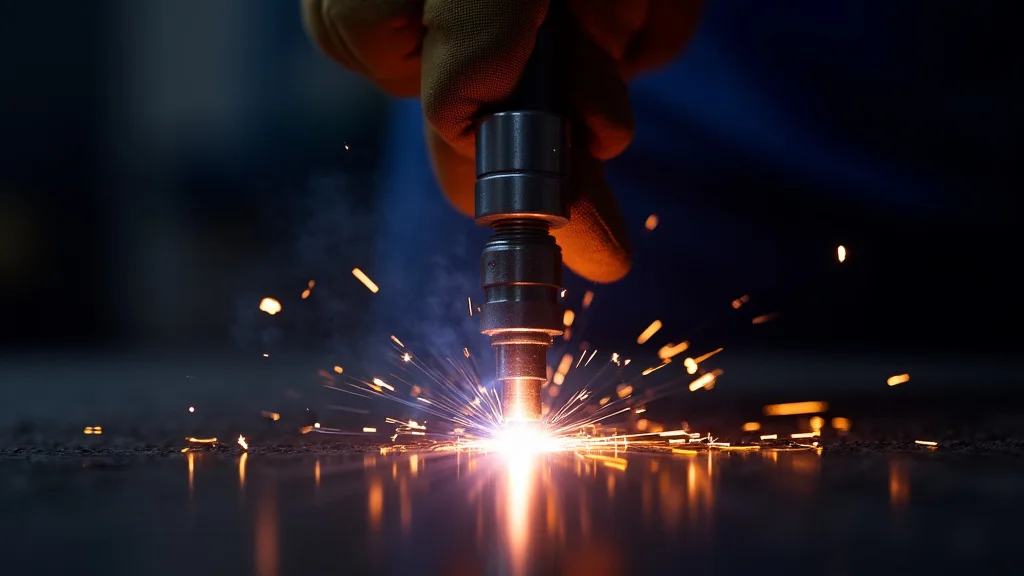
Getting good penetration when you MIG weld can be tricky for beginners. You want your weld to go deep into the metal, not just sit on top. This is super important for making strong joints.
But it’s easy to get wrong, and that’s okay! We’ll show you simple ways to fix this. Keep reading to learn how to get your welds to go where they need to.
We’ll start with some key things you should know.
Key Takeaways
- You will learn how welding current affects how deep your weld goes.
- Discover the best voltage settings for good penetration.
- Understand why wire speed is a big deal for weld depth.
- Find out how travel speed changes your weld’s reach.
- Learn about the right nozzle-to-work distance.
- See how different gas mixes can help your welds.
Understanding MIG Weld Penetration
What is Weld Penetration?
Weld penetration is how deep the heat from your MIG welder melts into the base metal. When you’re welding two pieces of metal together, you want the weld metal to fuse them all the way through. A weld that doesn’t go deep enough is called a “cold lap” or “lack of fusion.” This means the pieces aren’t really joined strongly.
Good penetration makes your welds strong and reliable. It’s the sign of a well-made weld.
Why is Penetration Important?
Think about building things. If you use glue to stick two pieces of wood together, but the glue only touches the very top surface, the wood will easily break apart. Welding is similar.
If the weld doesn’t sink into the metal, the joint will be weak. This is especially true for things that will hold weight or go under stress. For example, welding a car frame or a piece of equipment needs strong, deep welds.
Without it, your project could fail.
Common Challenges for Beginners
Beginners often struggle with getting the settings just right. There are several dials on a MIG welder: amperage (or wire speed), voltage, and sometimes even gas flow. Choosing the wrong combination of these can lead to welds that are too shallow or too hot.
People also have trouble with how fast they move the welder. If you move too fast, the metal doesn’t have time to melt deeply. If you move too slow, you can burn through or make a messy weld.
Getting the right angle and distance from the metal also plays a part. It takes practice to find that sweet spot.
Factors Affecting Penetration
Several things work together to determine how deep your MIG weld goes. It’s not just one setting. You need to think about them all.
We’ll go through each one so you can get a better grip on how they influence your weld.
1. Welding Current (Amperage)
The welding current, often controlled by your wire speed on a wire-fed welder, is a major player. Higher current means more heat. More heat melts more metal.
So, generally, a higher amperage setting will give you deeper penetration. But, there’s a limit. Too much heat can burn through thin metal or cause other problems.
For thicker metals, you’ll need more current to get good depth.
Wire Speed and Amperage
On many MIG welders, you don’t directly set the amperage. Instead, you set the wire speed. The wire speed tells the machine how fast to feed the welding wire.
A faster wire speed means more wire is going into the weld. More wire needs more heat to melt it, so the welder automatically increases the amperage to match. This is why adjusting wire speed is a key way to control how hot your weld is and, therefore, how deep it penetrates.
2. Welding Voltage
Voltage is like the “push” that drives the electricity through the arc. It affects the arc length and how wide the weld puddle becomes. A higher voltage usually creates a longer arc and a wider, flatter bead.
While it might seem like more voltage means more heat, it’s more about shaping the arc and the weld puddle. For deeper penetration, you often need the right balance of voltage and amperage. Too low a voltage can lead to a narrow, pinpoint arc with poor penetration.
Too high a voltage can make the arc unstable and spread out too much, leading to a shallow, wide weld.
Finding the Right Voltage
Many welders use charts or manuals to find good starting points for voltage based on the type and thickness of metal they are welding. For example, welding 1/4 inch steel might need a different voltage than welding 1/8 inch steel. The goal is to find a voltage that creates a stable, focused arc and a weld puddle that spreads just enough for good fusion.
3. Travel Speed
How fast you move your welding gun along the joint is critical. If you move too slowly, the heat builds up too much in one spot. This can cause you to burn through the metal, especially if it’s thin.
It can also lead to an excessively wide bead with less depth. On the other hand, if you move too quickly, the arc doesn’t have enough time to melt into the metal properly. This results in a shallow weld that sits on top of the base material.
The Sweet Spot for Travel Speed
The right travel speed is one that allows the weld puddle to form and flow properly, fusing the base metals without burning through or leaving a shallow bead. You want to see a nice, even bead with good fusion. Often, beginners try to move too fast.
Practicing with consistent speed is key. A good way to tell is to look at the weld puddle; it should be molten and slightly spread, following your gun.
4. Electrode Stick-Out (Contact Tip to Work Distance)
This is the length of the welding wire that extends from the tip of your MIG gun to the point where it touches the metal. This is also called “stick-out.” A longer stick-out generally leads to less current delivery to the arc and thus less penetration. A shorter stick-out means more current and deeper penetration.
However, too short a stick-out can cause the contact tip to overheat, leading to erratic wire feeding and poor weld quality. A general rule for steel is about 1/4 to 1/2 inch stick-out.
Consistent Stick-Out
Maintaining a consistent stick-out throughout your weld is important. Try to keep it the same length for the entire pass. This helps ensure that the amount of heat and penetration is uniform along the weld seam.
If your stick-out varies wildly, your weld quality will suffer.
5. Nozzle Angle and Position
The angle at which you hold your MIG gun can also influence penetration.
- Push vs. Pull: In MIG welding, you can either push the gun away from you or pull it towards you.
Pushing the gun (called “drag” or “pushing” depending on the process, but for MIG, it’s often called a “push” if the wire is angled forward) tends to create a wider bead with less penetration. Pulling the gun (called “drag” or “pulling”) generally leads to a narrower bead with deeper penetration.
- Angle to the Joint: Holding the gun straight up and down (perpendicular to the joint) is often best for even penetration. Angling the gun too much to the side can cause the weld to favor one piece of metal over the other, leading to uneven fusion.
For best penetration, especially on butt or fillet welds, try to maintain a slight drag angle (pulling the gun) and keep the gun as perpendicular to the weld joint as possible.
6. Shielding Gas
The shielding gas you use protects the molten weld puddle from the air, which contains oxygen and nitrogen. These elements can make your weld weak and brittle if they get in. The type of gas affects the arc characteristics and how the weld metal transfers.
- Pure CO2: This gas provides good penetration but can result in a wider, flatter bead with more spatter.
- Argon/CO2 mixes (e.g., 75% Argon / 25% CO2): These are very common and offer a good balance of penetration, a stable arc, and cleaner welds with less spatter compared to pure CO2.
- Pure Argon: This gas is typically used for aluminum or stainless steel and provides a softer arc and shallower penetration on mild steel.
For general steel welding where good penetration is desired, a mix like 75/25 Argon/CO2 is often a good choice. If you need deeper penetration, you might experiment with slightly higher CO2 content, but be mindful of increased spatter.
7. Base Metal Thickness
The thickness of the metal you are welding is a primary factor in determining the required settings. Thicker metals need more heat and often more time to penetrate properly. Welding thin metal requires less heat and careful control to avoid burning through.
For good penetration on thicker materials, you will need higher amperage (wire speed) and possibly a slightly higher voltage and slower travel speed. For thinner materials, you will need to reduce amperage, voltage, and travel speed.
Matching Settings to Metal
It’s crucial to match your welding settings to the thickness of the material. A welding machine manual or a welding chart can provide excellent starting points for different metal thicknesses. Always test your settings on scrap pieces of the same material before welding your actual project.
How to Improve Penetration in MIG Welding: Step-by-Step
Now that you know the factors, let’s put it into practice. Here’s a simple guide to help you get better penetration.
Step 1: Choose the Right Machine Settings
Start by consulting your welder’s manual or a welding chart. Find the recommended settings for the thickness of the metal you are working with. If you don’t have a chart, a good rule of thumb for mild steel is:
- For 1/8 inch (3mm) steel: Try around 130-150 wire speed and 17-19 volts.
- For 1/4 inch (6mm) steel: Aim for around 200-250 wire speed and 20-22 volts.
- For thicker steel (3/8 inch or more): You’ll need higher settings, often over 250 wire speed and 22+ volts.
These are just starting points. You will likely need to fine-tune them.
Step 2: Check Your Electrode Stick-Out
Ensure your wire is sticking out of the nozzle by about 1/4 to 1/2 inch (6-13 mm). Keep this distance consistent as you weld. If the wire is too long, you’ll get less heat.
If it’s too short, you risk hitting the workpiece with the nozzle or causing issues.
Step 3: Prepare Your Joint
For thicker metals (over 1/4 inch or 6mm), you often need to prepare the joint properly. This might mean beveling the edges of the metal. Beveling creates a V-groove or U-groove.
This gives the weld metal space to penetrate deeply and fill the joint. For thinner metals, a simple butt joint or fillet weld might be sufficient without extensive preparation.
Step 4: Position Your Gun Correctly
Hold the MIG gun at a slight drag angle (pulling the gun). This means the gun is angled slightly backward relative to your direction of travel. Also, try to keep the gun perpendicular to the weld joint.
This helps direct the heat and molten metal into the joint for good fusion.
Step 5: Weld and Observe
Start welding, moving at a steady, consistent speed. Watch the weld puddle. It should be a molten pool that flows smoothly into the joint.
If the puddle is too small and narrow, your travel speed might be too fast, or your heat settings too low. If the puddle is too large and spread out, you might be moving too slowly or have too much heat.
Step 6: Adjust as Needed
Based on what you see, make small adjustments.
- If penetration is too shallow: Increase wire speed slightly. You might also need to increase voltage slightly or slow down your travel speed.
- If you are burning through or the weld is too hot: Decrease wire speed.
You might also need to decrease voltage slightly or speed up your travel speed.
- If the weld looks rough or spattery: Check your shielding gas flow rate and ensure your contact tip is clean and not worn.
Keep your adjustments small and weld a test piece to see the effect before changing your main weld.
Step 7: Practice, Practice, Practice
The best way to learn how to improve penetration is by practicing. Weld on scrap pieces of the same material you’ll be using for your project. Experiment with the settings and techniques.
Over time, you’ll develop a feel for what looks and sounds right for a good, deep weld.
Common MIG Welding Problems and Solutions
Sometimes, even when you try to get good penetration, things don’t go as planned. Here are some common issues and how to fix them.
Problem: Weld Bead is Too Flat and Shallow (Cold Lap)
Causes:
- Wire speed too low
- Voltage too low
- Travel speed too fast
- Electrode stick-out too long
- Incorrect gas mix (not enough CO2 for steel)
Solutions:
- Increase wire speed.
- Increase voltage slightly.
- Slow down travel speed.
- Reduce electrode stick-out.
- Use a gas mix with more CO2 for steel.
Problem: Burn-Through or Undercut
Causes:
- Wire speed too high
- Voltage too high
- Travel speed too slow
- Electrode stick-out too short
- Incorrect joint preparation (too much gap)
Solutions:
- Decrease wire speed.
- Decrease voltage slightly.
- Speed up travel speed.
- Increase electrode stick-out.
- Ensure the joint has a suitable gap, or use backing if needed.
Problem: Excessive Spatter
Causes:
- Incorrect gas mix (too much Argon for steel)
- Dirty contact tip or nozzle
- Incorrect voltage or wire speed
- Arc length too long
Solutions:
- Use a gas mix with more CO2 for steel, or ensure your gas flow is correct.
- Clean the contact tip and nozzle regularly.
- Adjust voltage and wire speed to a stable range.
- Ensure your electrode stick-out is correct and voltage is not too high.
Problem: Inconsistent Arc
Causes:
- Dirty or worn contact tip
- Poor ground connection
- Damaged liner in the MIG gun
- Incorrect wire spool tension
- Moisture in the shielding gas
Solutions:
- Replace the contact tip if it’s worn or dirty.
- Ensure a clean, solid ground connection.
- Check the MIG gun liner for kinks or damage and replace if necessary.
- Adjust the spool tension so the wire feeds smoothly but not loosely.
- Use a fresh cylinder of gas.
Problem: Weld Puddle is Too Wide and Flat
Causes:
- Pushing the gun instead of dragging
- Travel speed too slow
- Voltage too high
- Gas mixture too high in Argon for steel
Solutions:
- Use a drag angle (pull the gun).
- Increase travel speed.
- Decrease voltage slightly.
- Use a gas mix with more CO2 for steel.
Frequently Asked Questions
Question: What is the most important setting for penetration in MIG welding?
Answer: The wire speed (which controls amperage) is often the most direct way to increase or decrease the heat, and therefore penetration. However, voltage and travel speed work together with wire speed to achieve the best results.
Question: Can I get good penetration on thin metal?
Answer: Yes, but it requires lower settings and careful control. You need to reduce wire speed and voltage significantly and maintain a consistent, often faster, travel speed to avoid burning through.
Question: Does the type of wire make a difference for penetration?
Answer: Yes. Different types of solid wires have different melting characteristics. For general steel welding, standard mild steel wires are common.
For specific applications, like welding stainless steel or using flux-cored wires (which are different from MIG but often confused), penetration can vary.
Question: How do I know if I have enough penetration?
Answer: Visually, a well-penetrated weld will have good fusion at the toes of the bead and, in some cases like a V-groove weld, the weld metal will appear to fill the groove evenly. For critical applications, destructive testing (like cutting a sample and examining the cross-section) is the only way to be sure.
Question: What is the best gas for deep penetration on steel?
Answer: For mild steel, a gas mixture with a higher percentage of Carbon Dioxide (CO2) tends to provide deeper penetration than mixes with high Argon content. A common and effective mix for good penetration is 75% Argon / 25% CO2, or even slightly more CO2.
Final Thoughts
Getting the right weld penetration is key to strong, reliable MIG welds. It’s about finding the perfect balance between your machine’s settings and how you move the gun. By adjusting your wire speed, voltage, and travel speed, and paying attention to your stick-out and gun angle, you can significantly improve how deep your welds go.
Remember to always test on scrap metal. With practice and by understanding these simple adjustments, you’ll be making deep, strong welds in no time. Keep welding!