
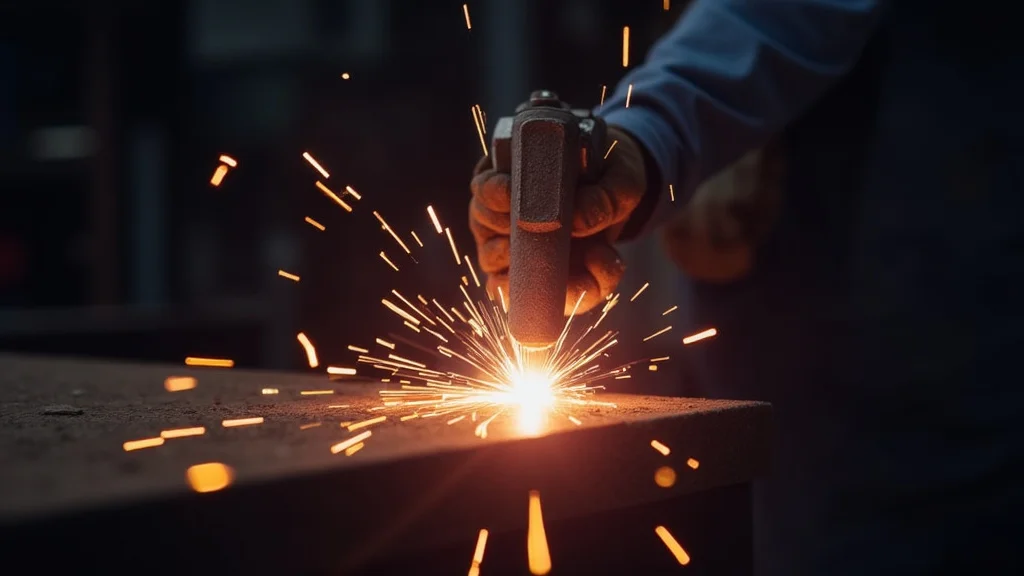
It’s common for new welders to wonder, “Why Is My MIG Arc Blowing Out During Welding?” This can be a bit confusing at first. It happens when the welding arc bends or blows away from where you want it. Don’t worry, though!
We’ll go through this step-by-step, and you’ll see how easy it is to fix. We’ll help you get your MIG welding back on track so you can make clean, strong welds.
Key Takeaways
- You will learn what causes MIG arc blow.
- You will discover how to adjust your welding machine settings to prevent arc blow.
- You will understand the importance of proper welding technique in controlling arc blow.
- You will see how the material you are welding can affect arc blow.
- You will gain tips on how to troubleshoot and fix arc blow problems.
Understanding MIG Arc Blow
What is MIG Arc Blow?
MIG arc blow is a problem where the welding arc, which is the stream of electricity that melts the metal, behaves erratically. Instead of staying straight and focused, it can get pushed sideways or even move around on its own. This makes it hard to control where the molten metal goes and can lead to weak or messy welds.
For beginners, it can feel like the arc is fighting you.
This happens because of magnetic forces. When electricity flows through the welding wire and the metal you’re welding, it creates a magnetic field. If these magnetic fields aren’t balanced, they can push the arc away from its intended path.
Think of it like trying to hold two magnets together that are trying to push each other apart.
Why Does It Happen?
Several things can cause these magnetic forces to get out of balance. The most common reasons relate to how electricity flows and where it’s coming from. When you’re welding, the electricity travels from your welding machine, through the welding gun, down the wire, into the metal, and then back to the machine through a ground clamp.
Any disruption in this path or strong magnetic fields can cause problems.
One major culprit is the direction of welding. When you weld in a certain direction, especially on thicker metals or when welding longer beads, the magnetic forces can build up. This buildup can then push the arc in a specific direction, usually opposite to your welding path.
This is particularly noticeable when you’re welding towards the end of a workpiece or when you’re welding near the ground clamp.
The Role of Magnetic Fields
Electricity moving through a conductor, like the welding wire or the workpiece, creates a magnetic field around it. These fields interact with each other. In MIG welding, the current flows down the wire, creating a magnetic field.
It also flows through the metal you’re welding, creating another magnetic field.
When these magnetic fields are aligned in a way that creates an unbalanced force, the arc gets pushed. It’s like the magnetic fields are trying to push the hot, ionized gas of the arc around. The stronger the current, the stronger the magnetic field, and the more likely arc blow is to occur.
This is why it’s more common with higher amperage settings.
Common Causes of MIG Arc Blow
Welding Current and Polarity
The amount of electricity (amperage) you use plays a big role. Higher amperages create stronger magnetic fields. If your settings are too high for the material thickness, you’re more likely to experience arc blow.
Your welding machine’s polarity also matters. For MIG welding, you typically use direct current electrode positive (DCEP). If this is set incorrectly, it can affect the magnetic forces.
Workpiece Material and Thickness
The type and thickness of the metal you’re welding can influence arc blow. Thicker metals can handle higher amperages, which, as we’ve seen, can increase magnetic forces. Also, some metals are more prone to magnetic effects than others.
Ferrous metals, like steel, are magnetic themselves, which can interact with the magnetic fields created by the welding current.
When welding on a piece of metal that is already magnetized, the arc blow can be significantly worse. Sometimes, especially with larger steel structures, residual magnetism from previous operations can be present. This can create an unpredictable magnetic environment for your arc.
Ground Clamp Placement
Where you attach your ground clamp is super important. The ground clamp completes the electrical circuit. When the current flows from the arc to the ground clamp, it creates magnetic forces.
If the ground clamp is too far from the weld area, or if it’s placed in a way that creates a strong magnetic field across your weld path, it can cause the arc to blow. This is one of the most common and easily fixed causes of arc blow.
Imagine the electricity taking a path from your arc to the ground. If this path is long or creates a strong magnetic pull, it can drag the arc with it. Keeping the ground clamp close to your weld, and ensuring it has a clean, solid connection to the workpiece, helps minimize this effect.
Welding Direction and Travel Speed
The direction you move your welding gun, called your travel direction, can also cause arc blow. When welding in a straight line, especially from left to right on many setups, the magnetic forces can build up and push the arc forward or backward. Similarly, if your travel speed is too fast or too slow, it can make arc blow worse.
If you’re moving too quickly, the arc doesn’t have enough time to establish a stable melt pool. If you’re moving too slowly, you can overheat the metal and increase the magnetic effects. Finding the right balance is key.
Wire Stick-Out
The amount of welding wire that sticks out from the contact tip of your welding gun, known as the wire stick-out, is another factor. If the stick-out is too long, it can lead to a weaker, more unstable arc. This instability can make the arc more susceptible to magnetic forces.
A consistent and appropriate stick-out is important for a stable arc.
A general rule of thumb for mild steel is about 1/2 inch (12-13 mm) stick-out for short-circuit transfer. For other modes of transfer or different wire types, this can change. Always check your wire manufacturer’s recommendations.
How to Prevent and Fix MIG Arc Blow
Adjust Your Machine Settings
Sometimes, the simplest solution is to adjust your welding machine. If you’re using too much amperage, try reducing it slightly. You might need to also adjust your wire feed speed to match.
The goal is to find a balance that gives you good penetration without excessive heat.
Experiment with different voltage and amperage settings. Sometimes, a slightly lower voltage can help stabilize the arc. Most modern MIG welders have charts that suggest settings based on wire diameter and material thickness.
Start with these recommendations and then fine-tune.
Change Ground Clamp Placement
This is a big one. If your arc is blowing consistently in one direction, try moving your ground clamp. Move it closer to your weld area.
Try different locations. Sometimes, moving it to the opposite side of where you’re welding can change the magnetic field enough to correct the problem.
If you’re welding a long seam, consider using two ground clamps. Place them on opposite ends of the seam. This can help distribute the current and reduce the magnetic pull on the arc.
Ensure both clamps have a clean, strong connection to the metal.
Alter Welding Direction
If you’re welding in a specific direction that causes arc blow, try welding in the opposite direction. Sometimes, simply changing your travel direction can make all the difference. If you’re welding a long joint, you might be able to alternate your welding direction on different passes.
For circular welds or corners, try to maintain a consistent travel direction. If you always weld counter-clockwise on a circle, and you get arc blow, try welding clockwise. You’ll find that one direction works better than the other.
Modify Travel Speed and Technique
Adjust your travel speed. If you’re moving too fast, slow down. If you’re moving too slow, speed up slightly.
You’re looking for a speed that allows for good metal transfer and puddle control without overheating.
Experiment with a slight weaving motion. A gentle side-to-side or circular motion can help spread the heat and distribute the magnetic forces more evenly. Don’t weave too wide, as this can lead to incomplete fusion.
The goal is to keep the arc focused and stable.
Control Wire Stick-Out
Ensure your wire stick-out is consistent and within the recommended range for your welding process and wire type. A short, consistent stick-out usually leads to a more stable arc. If your contact tip is worn or dirty, it can affect the stick-out and arc stability.
Keep your tip clean and replace it when it’s worn.
To achieve a consistent stick-out, you’ll need to trim the wire to the correct length after each wire feed adjustment or if the tip gets slightly damaged. This small step can have a significant impact on arc quality.
Use Anti-Sputter Sprays
While not a direct fix for arc blow itself, anti-sputter sprays can help. They prevent spatter from sticking to your contact tip and nozzle. When spatter builds up, it can obstruct the gas flow and affect the arc.
Keeping the nozzle clean ensures a smooth flow of shielding gas, which helps stabilize the arc.
Regularly clean your welding gun and contact tip. This includes wiping away spatter. A clean gun leads to a cleaner weld and a more predictable arc.
The anti-sputter spray is an aid to this cleaning process.
AC Welding (for specific materials)
While this is primarily about MIG welding (which is DC), it’s worth noting that for certain materials, like aluminum, some processes might use AC. The alternating current in AC welding naturally cycles through positive and negative, which can help to cancel out some of the magnetic forces that cause arc blow. However, for steel MIG welding, DC is standard.
If you are welding steel and arc blow is a persistent issue, stick to DC settings. The solutions we’ve discussed are focused on managing DC magnetic fields. AC is a different electrical behavior with its own set of considerations.
Demagnetizing
For very specific applications, especially when welding large steel structures, residual magnetism in the metal itself can be a problem. In these cases, specialized demagnetizing equipment might be used to reduce the magnetic field of the workpiece before welding. This is usually not something a beginner welder would need to worry about, but it’s good to know it’s an option for extreme cases.
For most common MIG welding tasks, focusing on machine settings, ground clamp placement, and technique will resolve arc blow issues. Demagnetizing is a more advanced solution for specialized environments.
Troubleshooting Common Scenarios
Arc Blow Towards the Ground Clamp
If your arc consistently blows towards the ground clamp, it means the magnetic field created by the current returning to the clamp is pulling the arc. To fix this, try moving the ground clamp closer to where you are welding. You can also try placing the ground clamp on the opposite side of your weld joint.
Another trick is to weld away from the ground clamp. If your ground clamp is on the left, try welding from right to left. This can change the magnetic polarity enough to counteract the pull.
Experiment to see which method works best for your setup.
Arc Blow at the End of a Weld
When you reach the end of a weld, especially a long one, the magnetic forces can build up. This can cause the arc to blow outwards as you finish. To combat this, try a slight “whipping” or circular motion as you complete the weld.
This helps dissipate the magnetic energy.
Also, consider increasing your travel speed slightly as you approach the end. This can help you finish the weld before the magnetic forces become too strong. Sometimes, a quick pause and then a faster exit can work.
Arc Blow When Welding Two Plates Together (Butt Joint)
When welding a butt joint, the current flows through both plates. This can create magnetic fields that interact. If you’re getting arc blow, try changing your welding direction.
If you’ve been welding from left to right, try welding from right to left.
You might also find that welding with a slight overlap in your weld beads, or using multiple passes, can help manage the magnetic forces better than trying to do it all in one pass. Ensure good fit-up between the plates.
Arc Blow with Flux-Cored Wire
Flux-cored wire, especially self-shielded types, can sometimes be more prone to arc blow than solid wire. This is often due to the flux ingredients interacting with the arc and magnetic fields. The same principles for solid wire apply, but you might need to be more diligent with machine settings and ground clamp placement.
Keep your wire stick-out consistent and ensure your machine settings are appropriate for the specific flux-cored wire you are using. Check the manufacturer’s recommendations, as they often provide specific guidance for their products.
Frequently Asked Questions
Question: Why does my MIG arc jump around when I start welding?
Answer: This is often due to initial magnetic forces as the arc strikes. Make sure your ground clamp is close and has a clean connection. Also, ensure your wire feed speed and voltage are properly set for the material you’re welding.
Question: Can the type of welding wire affect arc blow?
Answer: Yes, different types of welding wire can have varying effects. Flux-cored wires, for example, can sometimes be more susceptible to arc blow than solid wires due to the flux material. Always follow the manufacturer’s recommendations for the wire you are using.
Question: Is arc blow always a bad thing?
Answer: While arc blow can make welding difficult and lead to poor quality welds, it’s a phenomenon caused by magnetic forces. Understanding it allows you to control it. It’s not inherently “bad” if you can manage it, but uncontrolled arc blow is detrimental to good welds.
Question: What’s the easiest way to fix arc blow?
Answer: The easiest fixes usually involve adjusting the ground clamp position or changing your welding direction. Trying to move the ground clamp closer to your weld, or welding in the opposite direction you were before, often solves the problem quickly.
Question: Will using a smaller wire diameter help with arc blow?
Answer: Using a smaller diameter wire typically means you’ll be welding at lower amperages. Since arc blow is often caused by strong magnetic fields related to current, lower amperages can indeed reduce the likelihood of arc blow. However, make sure the wire diameter is still suitable for the thickness of the material you are welding.
Final Thoughts
Learning to control MIG arc blow is a key step for any welder. You’ve seen how magnetic forces can make your arc jump around. But now you know the common causes, from settings and ground clamps to direction and speed.
The good news is that most arc blow issues have simple fixes. By adjusting your machine, moving your ground clamp, or changing how you move your gun, you can tame that wandering arc. Keep practicing these tips, and you’ll be welding smoothly in no time.
Leave a Reply