
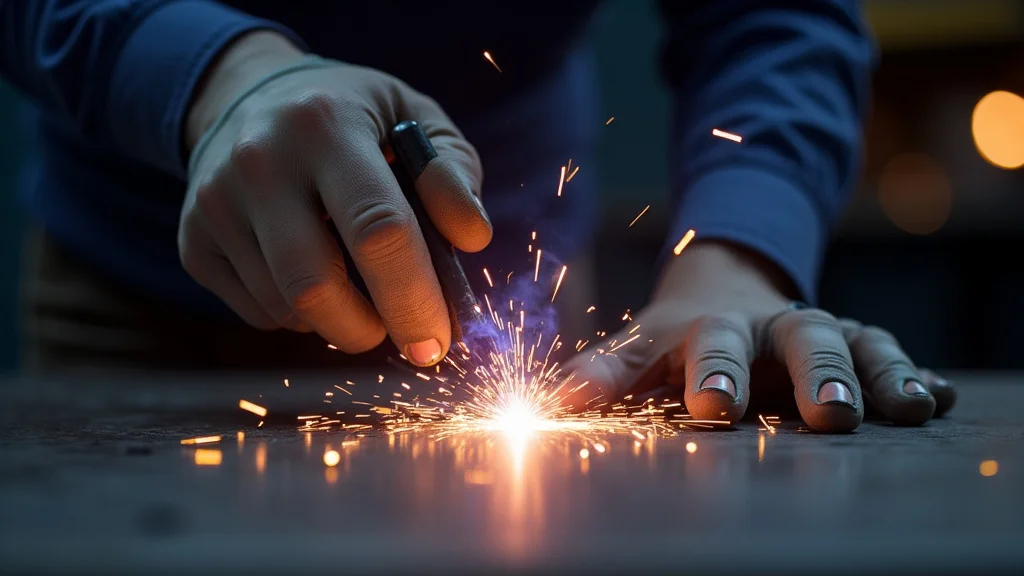
Welding is a skill that takes practice, and with MIG welding, you’ll often see little bits of metal, called spatter, stick to your work surfaces. It’s pretty common and can be a bit tricky for new welders to deal with. Don’t worry, though!
We’ll walk you through a simple way to get rid of that spatter and keep your welding projects looking clean. What we’ll cover next will make sure you know exactly what to do.
Key Takeaways
- You will learn why spatter happens during MIG welding.
- Discover easy methods to remove MIG welding spatter.
- Find out about useful tools and supplies for cleaning spatter.
- Understand how to prevent spatter in the first place.
- Learn how to keep your welding equipment in good shape by cleaning spatter.
Why MIG Welding Spatter Happens
The Basics of Spatter
MIG welding, also known as Gas Metal Arc Welding (GMAW), is a popular method for joining metal. It’s known for being fast and good for many types of projects. During this process, electricity melts a wire electrode and the base metal.
A shielding gas flows around the arc to protect it from air. Sometimes, as the molten metal transfers from the wire to the weld pool, small droplets can spray out and stick to nearby surfaces. This is what we call spatter.
For anyone just starting out with MIG welding, dealing with spatter can be a bit puzzling. You might wonder why it’s happening or how to get rid of it without damaging your project. It’s a common challenge, but it’s easy to manage once you know a few simple tricks.
Getting rid of spatter not only makes your welds look better but also helps your equipment last longer.
Common Causes of Spatter
Several things can cause spatter. One big reason is the welding voltage and wire speed. If these settings aren’t right for the metal you’re welding, you’ll get more spatter.
Too high a voltage or wire speed can make the metal spray out too much. On the other hand, settings that are too low might not give you a stable arc.
The type of welding gas you use also plays a role. For MIG welding, mixtures of argon and CO2 are common. The amount of CO2 can affect spatter.
More CO2 often means more spatter. Also, the distance between your welding gun tip and the workpiece, known as stick-out, matters. If the stick-out is too long, the arc can become unstable, leading to spatter.
Contaminated metal can also be a culprit. If the surface you’re welding has rust, paint, or oil on it, it can interfere with the arc and cause spatter. Even the quality of your welding wire can make a difference.
Cheap or old wire might have coatings that cause more issues.
How to Clean Spatter from MIG Welding Surfaces
Tools and Supplies You’ll Need
To tackle spatter, you’ll want a few handy items. A good wire brush is a must. It’s great for scrubbing off dried spatter.
For tougher spots, a metal scraper or a chipping hammer can be very useful. These tools help to chip away at stubborn spatter without scratching the base metal too much if used carefully.
You’ll also want some protective gear. Always wear safety glasses or a face shield to protect your eyes from flying debris. Gloves are important for a good grip and to protect your hands.
If you’re using chemicals, good ventilation is key, and you might need chemical-resistant gloves.
For cleaning, a good degreaser can help remove oils and grime before or after welding. Some welders also use anti-spatter spray. This spray creates a barrier on the nozzle and surrounding surfaces, making it harder for spatter to stick.
Method 1: Mechanical Removal
The simplest way to clean spatter is by physical force. This is often the first thing people try. Once the weld has cooled down a bit, you can use a wire brush.
Gently scrub the areas where spatter has landed. For most fresh spatter, this will be enough to loosen and remove it.
If brushing isn’t enough, a chipping hammer can be used. Tap gently on the spatter blobs. They should break away from the surface.
Be careful not to hit too hard, as you could dent or damage the metal you’re working on. After chipping, you can use the wire brush again to clean up any remaining bits.
A metal scraper can also be effective, especially for larger spatter marks. Use the edge of the scraper to lift the spatter off the surface. Again, a light touch is important to avoid scratching your work.
Always follow up with a wire brush to ensure the surface is smooth.
Method 2: Using Anti-Spatter Products
There are special products designed to prevent spatter from sticking in the first place. Anti-spatter spray is applied to the welding gun nozzle, tip, and the area around the weld seam before you start welding. This creates a non-stick coating.
When spatter does land on a surface treated with anti-spatter, it’s much easier to wipe away. You can often just use a clean cloth. If it’s a bit more stuck, a light brushing will usually do the trick.
These products come in sprays, gels, and even paints. They are safe for most metal surfaces and won’t interfere with your weld quality.
Remember to reapply anti-spatter regularly during long welding sessions. This ensures the protective layer stays effective. Using anti-spatter products saves a lot of cleaning time and effort later on, making the whole welding process smoother.
Method 3: Chemical Cleaning
For very stubborn spatter or when you need a perfectly clean surface, chemical cleaners can be helpful. There are specific de-spatter solutions available. These are often solvents that break down the spatter.
You apply them to the spatter, let them sit for a short time, and then wipe or brush away the loosened material.
Always follow the instructions on the product label. Some chemicals require good ventilation, and you’ll need to wear gloves. After using a chemical cleaner, it’s a good idea to rinse the surface with water or wipe it down with a clean, damp cloth to remove any residue.
Make sure the surface is completely dry before you weld again.
Be cautious when using chemicals on painted or coated surfaces, as they might damage the finish. Always test a small, hidden area first if you’re unsure. For general metal cleaning, a mild degreaser before welding can remove oils and grease, which also helps reduce spatter.
Preventing Spatter in the First Place
The best way to deal with spatter is to prevent it from happening. Adjusting your welding machine settings is key. Make sure your voltage and wire speed are set correctly for the thickness of the metal and the type of wire you are using.
Consult your welding machine’s manual or refer to welding charts for recommended settings. Often, finding the “sweet spot” for your machine and material will significantly reduce spatter.
Using the correct welding gas and flow rate is also important. A stable flow of shielding gas protects the weld pool from air. Too much or too little gas can lead to arc instability and increased spatter.
Keep your welding gun nozzle clean and free of spatter buildup. Spatter on the nozzle can disrupt the gas flow and the electrical contact, leading to a poor arc and more spatter.
Maintain the correct gun-to-workpiece distance (stick-out). A consistent and appropriate stick-out helps create a stable arc. Typically, for .030 inch wire, a stick-out of about 1/4 to 3/8 inch is recommended.
Ensure your welding wire is clean and free from rust or dirt. Storing wire properly helps maintain its quality.
Cleaning Your MIG Gun and Nozzle
Regularly cleaning your MIG gun and nozzle is vital. After each welding session, turn off your machine. Let the gun cool down.
Use a wire brush to clean any spatter from the outside of the nozzle. You can also use a small reamer tool or a drill bit by hand to clean the opening of the nozzle.
The contact tip, which the welding wire passes through, is very important. If spatter builds up here, it can restrict wire feeding and affect the electrical connection. You can often use pliers to gently pull out spatter stuck inside the tip.
Some welders use a small hammer and punch to tap spatter out of the tip. For a more thorough clean, you can replace the contact tip entirely. They are inexpensive and easy to swap out.
Inspect the wire feeder system too. Make sure the drive rolls are clean and the tension is set correctly. Dirt or debris in the wire path can cause feeding issues and contribute to spatter.
A clean MIG gun means a more stable arc and less spatter on your work.
Frequently Asked Questions
Question: Is MIG welding spatter harmful to my health?
Answer: While small amounts of spatter are generally not harmful if you take basic precautions, welding produces fumes and particles. It’s important to always wear a welding helmet with proper shade, safety glasses, and consider using a respirator if welding in a poorly ventilated area, especially for prolonged periods.
Question: Can I just leave the spatter on my project if it’s not going to be seen?
Answer: It’s best to remove spatter even if it’s not in a visible area. Spatter can weaken the metal surface, create stress points, or interfere with any subsequent coatings or treatments you plan to apply. Cleaning it ensures a better overall finish and integrity of your work.
Question: What’s the difference between MIG spatter and arc blow?
Answer: MIG welding spatter refers to the small droplets of molten metal that spray out during the welding process and stick to surfaces. Arc blow, on the other hand, is the deflection of the electric arc caused by magnetic forces, which can lead to erratic welding and increased spatter, but it’s more about the arc’s behavior.
Question: How often should I clean my MIG gun nozzle?
Answer: It’s a good practice to clean your MIG gun nozzle every time you weld. Even a quick wipe down to remove fresh spatter will prevent buildup and ensure consistent performance. For longer welding jobs, you might need to clean it more frequently.
Question: Can I use just any household cleaner to remove spatter?
Answer: It’s generally not recommended to use any household cleaner. Some household cleaners can leave residues that interfere with the weld or damage the metal. It’s best to use products specifically designed for welding spatter removal or common degreasers and solvents meant for metal.
Final Thoughts
Keeping your MIG welding surfaces clean from spatter is an important part of good welding practice. You learned that spatter happens due to settings, gas, and technique. Simple tools like wire brushes and scrapers work well for removal.
Using anti-spatter products before welding can greatly reduce the problem. Remembering to clean your MIG gun and nozzle regularly also makes a big difference.
Taking these steps will help you achieve cleaner welds and keep your equipment in top shape. It’s all about consistent practice and using the right methods. You’ll find that a little effort in cleaning makes your projects look much more professional and your welding experience much smoother.
Keep practicing these techniques, and you’ll be a spatter-cleaning pro in no time.

Leave a Reply