
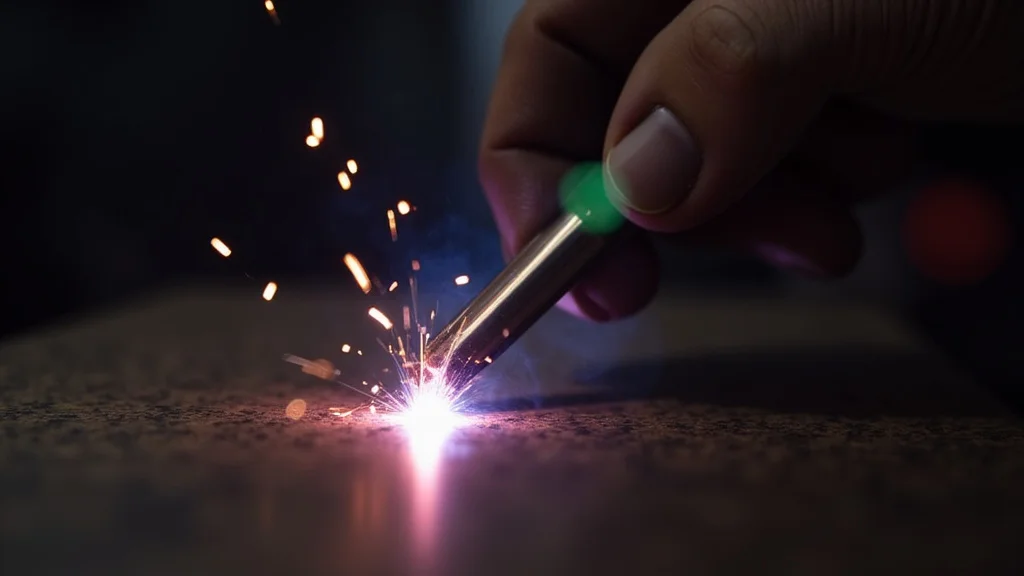
When you’re starting out with TIG welding, you might find yourself asking, “TIG Welder Arc Too Short? Troubleshoot” often. It’s a common puzzle for new welders because getting the arc length just right feels tricky.
Don’t worry, though! This guide will walk you through it simply, step by step. We’ll look at why this happens and how to fix it so you can weld with confidence.
Ready to get your TIG arc just right?
Key Takeaways
- You will learn what causes a TIG welding arc to be too short.
- You will find out how to adjust your TIG welding technique to lengthen the arc.
- You will understand the role of amperage and travel speed in arc length.
- You will discover how electrode angle affects the TIG arc.
- You will learn how to fix common problems that lead to a short arc.
- You will gain confidence in controlling your TIG arc for better welds.
What Makes a TIG Welder Arc Too Short?
A short TIG arc happens when the distance between your electrode tip and the workpiece is too small. It can feel like you’re dragging the tungsten too close to the metal. This can make welding difficult and lead to poor weld quality.
You might see sputtering, a weak puddle, or the tungsten can even stick to your work. It’s a common snag for anyone new to TIG welding.
Your Hand and the Electrode
The biggest reason for a short arc is how you hold your torch. If you’re too close to the metal, the arc gets squeezed. Think of it like trying to light a tiny candle very close to your finger.
It’s hard to see and control. Beginners often do this because they’re trying to be precise or are worried about losing their spot. They end up keeping the torch tip much too near the base material.
The tungsten electrode itself is designed to have a certain sticking-out length from the gas nozzle. This length affects how far the arc can travel without getting disturbed by gas flow or hitting the workpiece. If this distance is too small, you’re already starting with a short arc.
Amperage Settings
The amount of power you use, called amperage, also plays a big part. If your amperage is too low for the material you’re welding, you might feel the need to get closer to the metal to try and make the weld happen. This naturally leads to a shorter arc.
It’s like trying to boil water with a very weak flame; you’d want to hold the pot closer to get more heat.
Too high an amperage can also be a problem, though it usually leads to a longer arc that is hard to control. But if you’re trying to compensate for a low heat input by getting closer, then low amperage is definitely a cause of a short arc.
Travel Speed
How fast you move your TIG torch across the metal, your travel speed, is another key factor. If you move too slowly, the heat builds up too much in one spot. To try and control this excessive heat and prevent blowing through the metal, you might instinctively pull the torch closer.
This reduces the arc length. It’s a reaction to manage the heat, but it often creates a new problem – a short arc.
On the flip side, moving too fast can also cause issues. If you move too quickly, the arc doesn’t have enough time to melt the metal properly. You might then try to get closer to force the heat into the joint, again resulting in a shorter arc.
Gas Flow and Coverage
The shielding gas is super important in TIG welding. It protects the molten weld pool from the air, which can cause contamination. If your gas flow is too low, the shielding gas might not be reaching the weld zone effectively.
This can cause issues that make you want to move the torch closer to the metal, leading to a shorter arc. A weak gas flow can also make the arc unstable, and you might feel the need to get closer to try and steady it.
The angle of your torch also matters for gas coverage. If your torch is angled too much, the gas might swirl away from the weld puddle instead of protecting it. This instability can cause you to shorten your arc.
Tungsten Electrode Condition
The tip of your tungsten electrode is what initiates and sustains the arc. If the tip is not prepared correctly, or if it gets contaminated, it can affect the arc. For instance, a tungsten that has been balled up or is dirty might not create a focused arc.
This could make you feel like you need to be closer to the metal to get a good melt, leading to a short arc.
The type of tungsten you use and how you grind it are also important. For most TIG welding, you want a nice, clean, pointed tip. If it’s too blunt or rounded, it won’t create a stable, predictable arc.
This can lead to inconsistent arc lengths.
Troubleshooting a Short TIG Arc: Step-by-Step
Fixing a short TIG arc is all about understanding what’s going on and making small adjustments. Follow these steps, and you’ll be setting the right arc length in no time.
Step 1: Check Your Torch Position
This is the most common culprit. Stand back and look at your torch. How far is the tip of your tungsten from the metal?
For most TIG welding, you want to keep the tungsten about the same distance from the metal as the diameter of the tungsten electrode itself. For example, if you’re using a 1/16 inch tungsten, aim for about a 1/16 inch arc gap. Some people say one electrode diameter is a good rule of thumb for the tungsten stick-out from the cup, and another for the arc gap itself.
- Hold steady: Try to keep your hand and torch movement very steady.
- Practice the distance: Practice holding the torch at that consistent distance without even striking an arc. Get a feel for it.
- Use your surroundings: If you’re welding on a flat surface, your hand can rest on the table or workpiece for stability.
Step 2: Adjust Your Amperage
Is your amperage set correctly for the thickness and type of metal you’re welding? If it’s too low, you might be tempted to get closer. Consult a TIG welding amperage chart for guidance.
Generally, you want enough amperage to melt the metal smoothly without having to force it by getting too close.
- Start with recommendations: Use a TIG amperage chart as a starting point.
- Fine-tune as needed: You might need to slightly increase amperage if you can’t maintain a good arc length and puddle.
- Watch the puddle: A good amperage setting lets you form a nice, fluid puddle without burning through or having to get too close.
Step 3: Control Your Travel Speed
A consistent travel speed is crucial. If you move too slowly, the heat builds up, and you might feel the urge to shorten your arc to compensate. If you move too fast, you won’t melt enough metal, and you might then try to get closer to force it.
- Find a steady rhythm: Aim for a consistent pace that allows the arc to melt the metal just enough to form a smooth, flowing puddle.
- Watch the puddle shape: A puddle that’s too wide and flat might mean you’re moving too slowly. A puddle that’s too narrow and deep might mean you’re moving too fast.
- Practice consistent movement: Try to keep your torch moving at a uniform rate across the joint.
Step 4: Ensure Proper Gas Flow
Make sure your shielding gas is flowing correctly. Too little gas means poor protection and an unstable arc, which can lead to you shortening your arc. Too much gas can cause turbulence and blow the shielding away from the weld area.
- Check your regulator: Ensure the flow rate is set according to the manufacturer’s recommendations or general guidelines for your gas.
- Test gas coverage: Hold your torch in position and briefly turn on the gas. You should feel a steady stream of gas.
- Observe the puddle: With proper gas flow, the molten puddle will look clean and shiny, not dull or discolored.
Step 5: Inspect Your Tungsten Electrode
Your tungsten electrode should be clean and properly sharpened. A balled-up or contaminated tip will not produce a stable, focused arc, potentially leading to a short arc length.
- Grind your tungsten: For DC welding, grind your tungsten to a sharp point. For AC welding (like on aluminum), you might want a slightly rounded tip.
- Keep it clean: Avoid touching the tungsten to the workpiece or filler metal, as this contaminates it. If it does get contaminated, re-grind it.
- Use the right type: Different tungsten types are suited for different materials and currents.
Step 6: Check Your Electrode Stick-Out
The amount of tungsten sticking out from the gas nozzle (the cup) affects your arc. If you have too much tungsten sticking out, the gas flow can be disturbed. If you have too little, it can cause the tungsten to hit the workpiece or cup, leading to a short arc.
- General rule: For most standard cups, aim for about 1/4 to 1/2 inch of tungsten sticking out.
- Smaller cups: With smaller cups, you might need less stick-out.
- Tungsten angle: Keep the tungsten electrode pointing straight out from the center of the cup.
Step 7: Consider Your Electrode Angle
The angle at which you hold your torch can influence the arc. Holding the torch too flat can cause the gas to be less effective and might make you feel like you need to get closer. Try to keep the torch angled slightly into the direction of travel.
- Drag technique: For most TIG welding, you want to use a slight drag angle, meaning the torch is angled back slightly from the direction you are moving.
- Keep it consistent: Maintain a consistent angle throughout your weld.
- Avoid “pushing”: Pushing the torch (angling it forward) is generally not recommended for most TIG applications and can lead to arc control issues.
TIG Welder Arc Too Short? Troubleshooting Chart
Sometimes, a quick reference is helpful. Here’s a chart to help you pinpoint the problem and its fix.
| Problem | Likely Cause | Solution |
|---|---|---|
| Short, sputtering arc | Electrode too close to workpiece | Increase distance between tungsten and metal (aim for 1 electrode diameter). |
| Tungsten sticks to metal | Electrode too close; Low amperage; Moving too fast | Increase distance; Increase amperage; Slow down travel speed. |
| Weak or unstable puddle | Low amperage; Poor gas coverage; Wrong tungsten | Increase amperage; Ensure correct gas flow; Check tungsten condition and grind. |
| Arc seems hard to control | Electrode too close; Inconsistent travel speed; Incorrect torch angle | Maintain consistent arc gap; Steady travel speed; Correct torch angle. |
| Tungsten burning up quickly | Too much amperage; Incorrect tungsten type; Too much stick-out | Reduce amperage if possible; Use correct tungsten type; Adjust stick-out. |
Frequently Asked Questions
Question: How far should the tungsten be from the metal when TIG welding?
Answer: A good rule of thumb is to keep the tungsten electrode about the same distance from the metal as the diameter of the tungsten itself. For example, with a 1/16 inch tungsten, aim for a 1/16 inch arc gap.
Question: Can too much travel speed cause a short arc?
Answer: Yes, it can. If you move too fast, the arc doesn’t have enough time to melt the metal properly, and you might instinctively get closer to compensate, leading to a shorter arc.
Question: What if my TIG arc is too short even when I try to keep it far away?
Answer: This could mean your amperage is too low, your gas coverage is not good, or your tungsten is not prepared correctly. Check those factors.
Question: Does the type of tungsten affect arc length?
Answer: While the type of tungsten doesn’t directly set your arc length, the way it’s ground and its cleanliness can affect arc stability. An unstable arc might make you feel like you need to shorten it.
Question: Is it okay for the tungsten to sometimes touch the workpiece?
Answer: No, it’s not okay. If your tungsten touches the workpiece, it will contaminate the tungsten and likely ruin the weld. You’ll need to stop, re-grind the tungsten, and restart.
Final Thoughts
Getting your TIG arc length right is key to making good welds. Remember to check your torch distance first, as it’s the most common issue. Make sure your amperage and travel speed are appropriate for the job.
Good gas flow and a properly prepared tungsten electrode will also help a lot. Practice these steps, and you’ll soon find your TIG arc behaves just how you want it to, leading to cleaner, stronger welds.
Leave a Reply