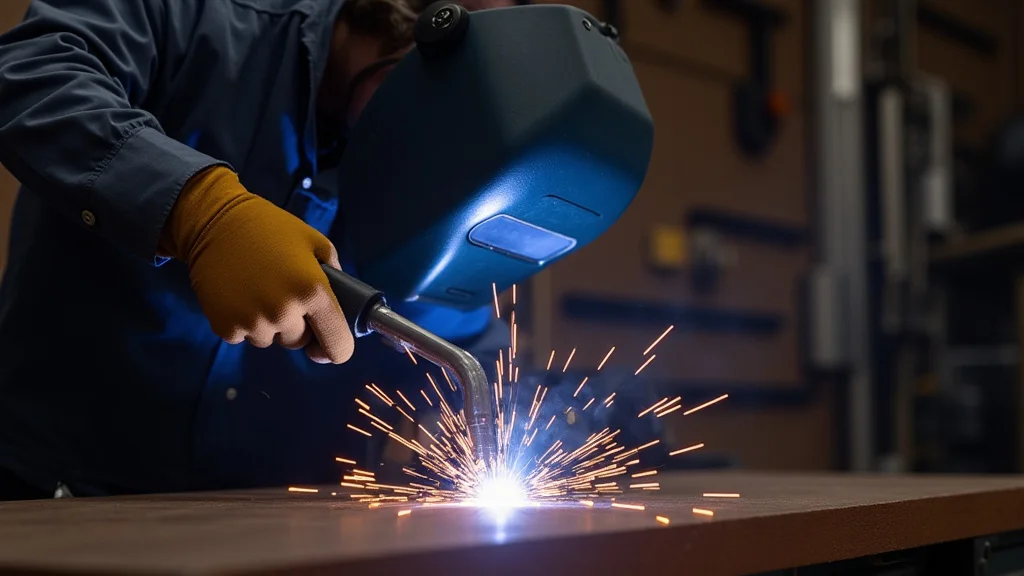
Trouble with your MIG welder’s gas? It’s easy for beginners to hit a snag with the gas shield. You might see sparks flying everywhere or welds that look rough.
But don’t worry! This is a super common thing, and we’ve got a simple way to fix it. We’ll show you exactly what to check and how to get your welder working right again.
Let’s make your welding projects smooth sailing.
Key Takeaways
- You’ll learn why your MIG welder’s gas might not be working right.
- We’ll show you the most common spots where gas can leak or get blocked.
- You’ll discover easy checks to find the problem fast.
- We’ll guide you through fixing these issues step-by-step.
- You’ll get tips to keep your gas shield working well for better welds.
Why Your MIG Welder Gas Shield Matters
What Is a Gas Shield?
Your MIG welder uses a special gas to protect the hot metal you’re welding. Think of it like an invisible umbrella. This gas flows from your welder and surrounds the welding arc and the molten metal.
Its main job is to push away air. Air has oxygen and nitrogen, which can make your weld weak and brittle if they get into it.
The Problem with Air
When air gets into your hot, melting metal, it causes problems. It can create little holes, called porosity, inside your weld. It can also make the weld brittle, meaning it might break easily later.
This is why getting the gas shield just right is super important for strong, good-looking welds.
Common MIG Welder Gas Shield Issues for Beginners
Not Enough Gas Flow
One of the most frequent problems beginners face is simply not getting enough gas to the welding area. This can happen for several reasons. The regulator might be set too low, or there could be a blockage somewhere in the gas line.
Too Much Gas Flow
On the flip side, too much gas can also be bad. If gas is blowing too hard, it can actually stir up the air and push it into the weld. It can also make the flame on your welder unstable and harder to control.
Finding that sweet spot is key.
Gas Leaks
Gas leaks are a big culprit. If your gas is escaping before it gets to the welding torch, you won’t have enough protecting your weld. These leaks can happen in many places, from the gas bottle connection to the torch itself.
Blocked Gas Orifices
Inside your welding torch, there’s a small opening where the gas comes out. This is called the gas orifice. If this gets clogged with dirt, spatter, or other debris, the gas flow will be reduced or stopped completely.
This is a very common issue.
Wrong Gas Type
For MIG welding, you usually use a mix of gases, like argon and CO2. Using the wrong gas, or a gas mix that’s not right for your welding project, can lead to poor weld quality. Different metals and welding situations need different gas mixes.
Simple Steps for a MIG Welder Gas Shield Issue? Quick Fix
Step 1: Check Your Gas Bottle and Regulator
First, make sure your gas bottle has enough gas. Look at the gauge on the regulator attached to the bottle. If it’s low, you’ll need to get a new one or refill it.
Next, check the regulator’s flow rate setting. For most MIG welding, a flow rate of around 15-25 cubic feet per hour (CFH) is a good starting point. This can change depending on the gas you’re using and your welding conditions.
Step 2: Inspect the Gas Line and Connections
Follow the gas line from the bottle to your welding machine. Look for any visible kinks, cracks, or damage. Make sure all connections are tight.
This includes where the gas line connects to the regulator and where it enters your welder.
You can check for leaks by applying a little soapy water to the connections while the gas is on. If you see bubbles forming, you have a leak. Tighten the connection or replace any faulty fittings.
Step 3: Examine the Welding Gun and Gas Nozzle
Look closely at the welding gun. The gas nozzle is the outer cup that surrounds the contact tip. Make sure it’s clean and free of spatter.
Spatter can build up and block the gas flow.
The gas orifice is inside the nozzle, where the gas exits. Sometimes, you can see it if you unscrew the nozzle. If it looks dirty or clogged, carefully clean it out with a small wire brush or a cleaning tool designed for welding tips.
Step 4: Test the Gas Flow
With your welder plugged in and the gas bottle turned on, try pulling the trigger on your welding gun. You should hear and feel the gas flowing. If you don’t, there’s a blockage or leak somewhere that needs attention.
To get a better idea of the flow, you can use a flow meter if you have one. This will give you an exact reading of the gas flow rate coming out of the torch. If you don’t have a flow meter, you can sometimes hear the gas escaping when you pull the trigger.
Step 5: Adjust Your Settings
Once you’ve fixed any leaks or blockages, you can fine-tune your gas flow. Start with the recommended setting for your welding machine and wire type. Make short test welds on scrap metal and observe the results.
If your welds have porosity or look rough, try increasing the gas flow slightly. If the gas seems to be blowing too hard and making the arc unstable, reduce the flow. Good welds will have a consistent, smooth bead without lots of spatter.
Troubleshooting Common Scenarios
Scenario 1: Welds are Porous
If your welds have little holes (porosity), the gas shield isn’t doing its job. This usually means either not enough gas is reaching the weld pool, or outside air is getting in.
- Check for leaks: A small leak anywhere in the gas system can cause this.
- Increase gas flow: Try increasing the flow rate on your regulator a little.
- Clean the nozzle: Make sure the gas nozzle is clean and not clogged with spatter.
- Torch angle: Keep your welding torch at a slight drag angle and directly over the weld joint.
Scenario 2: Arc is Unstable and Lots of Spatter
An unstable arc and excessive spatter often point to too much gas flow. The gas is blowing the molten metal around too much.
- Decrease gas flow: Turn down the flow rate on your regulator.
- Check nozzle condition: Ensure the nozzle is not damaged or bent, which can disrupt gas flow.
- Proper shielding gas: Make sure you are using the correct shielding gas for the metal you are welding.
Scenario 3: No Gas Coming Out
If you pull the trigger and hear nothing, the problem is more serious.
- Is the bottle open? Double-check that the gas bottle valve is fully open.
- Regulator issue: The regulator might be faulty.
- Blockage in the gun: The gas line inside the welding gun could be completely blocked.
- Wire feed issue: Sometimes, a problem with the wire feeder can affect gas flow.
When to Seek Professional Help
Most MIG welder gas shield issues are simple to fix with basic checks. However, if you’ve gone through these steps and are still having trouble, it might be time to get some expert help. This could mean taking your welder to a repair shop or contacting the manufacturer’s support.
Sometimes, a part inside the welding machine itself might be damaged. This could be a faulty solenoid valve that controls gas flow or a problem within the wire feeder system. These are typically not simple DIY fixes.
Frequently Asked Questions
Question: How do I know if I’m using the right gas for my MIG welding?
Answer: The type of gas you use depends on what you’re welding. For steel, a mix of argon and CO2 is common. For aluminum, pure argon is usually best.
Your welding machine manual or the wire spool packaging will tell you the recommended gas.
Question: What’s the difference between drag and push welding with MIG?
Answer: Drag welding means you pull the gun away from the direction of travel, with the wire feeding into the leading edge of the puddle. Push welding means you push the gun, with the wire feeding into the trailing edge. Drag is common for steel, while push is often used for aluminum.
Question: How often should I clean my MIG gun nozzle?
Answer: It’s a good idea to clean your nozzle regularly, especially if you do a lot of welding. A quick clean every time you change your spool of wire or if you notice spatter buildup is recommended. Keeping it clean helps maintain proper gas flow.
Question: Can I use CO2 gas by itself for MIG welding?
Answer: Yes, you can use pure CO2 gas for MIG welding, especially on steel. However, it tends to produce more spatter and can sometimes lead to less control than a gas mix. Gas mixes are often preferred for a smoother weld and better appearance.
Question: What should I do if my gas bottle runs out of gas mid-weld?
Answer: If your gas runs out mid-weld, stop welding immediately. You’ll likely see a lot of spatter and poor weld quality because the gas shield failed. Get a new gas bottle, connect it, check for leaks, and then resume welding on fresh material.
Final Thoughts
Fixing a MIG Welder Gas Shield Issue? Quick Fix is all about checking the simple things first. Your gas bottle, connections, and torch nozzle are the usual suspects.
By regularly inspecting these parts and making sure your gas flows freely and without leaks, you’ll get stronger, cleaner welds. Don’t let gas problems slow you down; a little attention keeps your MIG welder running smoothly for all your projects.