
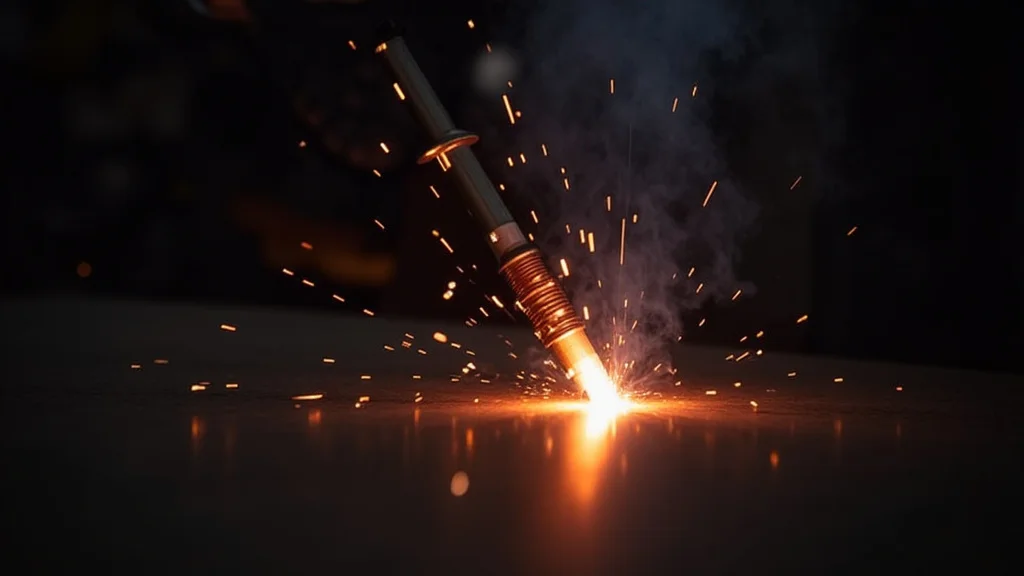
Learning stick welding is exciting, but sometimes the arc can be wiggly and uneven. This can make your welds look messy and make beginners feel frustrated. Many people learning to stick weld run into this issue.
But don’t worry! This guide will show you easy steps to fix it. We’ll help you get a smooth, steady arc so your welds look great.
Key Takeaways
- You will learn the main reasons why a stick welding arc becomes uneven.
- We will explain how to adjust your welding machine settings for a stable arc.
- You will discover the importance of electrode angle and travel speed.
- We’ll cover how different welding rods affect arc stability.
- You’ll find out how to check and fix common problems with your equipment.
- This post will guide you to achieve cleaner, more consistent welds.
Why Stick Welding Arcs Get Uneven
An even, steady arc is the goal for every stick welder. It makes welding easier and your welds look better. But sometimes, the arc seems to jump around.
It might be too wide, too narrow, or just unsteady. This unevenness can happen for several reasons. Understanding these reasons is the first step to fixing them.
Let’s look at what causes an uneven arc.
Common Causes of an Uneven Arc
Incorrect Amperage Settings
Amperage is like the “heat” of your weld. Too much amperage can make the arc too hot and spread out. This makes it hard to control.
Too little amperage, and the arc might be weak and sputtery. It won’t melt the metal properly. Finding the right amperage for your metal thickness and electrode is key.
This is often the most common reason for an uneven arc.
Wrong Electrode Type or Size
Stick welding uses different types of welding rods, called electrodes. Each rod has a specific job and works best with certain amperages. Using a rod that’s too big or too small for the job can cause problems.
Some rods are designed for smoother arcs than others. For example, a 6013 rod often has a more stable and spray-like arc than a 6010 rod. The coating on the electrode also plays a big role in how the arc behaves.
Poor Electrode Angle
The angle you hold the welding rod matters a lot. If you push or drag the rod too much, or if it’s at a bad angle to the metal, the arc can become uneven. A consistent angle helps maintain a steady melt pool and control the weld bead.
A slight drag angle is often recommended for many electrodes, but it can vary.
Inconsistent Travel Speed
How fast you move the welding torch or electrode along the joint is called travel speed. If you move too fast, the weld bead will be thin and might have gaps. If you move too slow, you can build up too much metal and cause an uneven bead.
A steady, consistent speed is needed for a good weld. The arc will follow your movement, so if your speed is jerky, the arc will be too.
Contaminated Base Metal
The metal you are welding on needs to be clean. Dirt, rust, grease, or paint on the metal surface can interfere with the arc. These contaminants can cause splattering and make the arc unstable.
Always clean the metal before you start welding.
Moisture in the Electrode
Some welding electrodes can absorb moisture from the air. This moisture can cause the arc to be erratic and sputtery. It can also lead to porosity in your weld.
If you suspect your electrodes are old or have been stored improperly, you might need to bake them in a special oven to dry them out.
Issues with the Welding Machine or Cables
Sometimes, the problem isn’t with your technique or the electrode. It could be with your welding equipment. Loose connections, damaged cables, or a faulty welding machine can all lead to an unstable arc.
Make sure all your connections are tight and that the cables are in good condition.
Incorrect Polarity
Stick welding machines can be set to different polarities: DC (Direct Current) or AC (Alternating Current), and within DC, either electrode positive (DCEP) or electrode negative (DCEN). The type of electrode you are using will have a recommended polarity. Using the wrong polarity can make the arc unstable, affect penetration, and change the appearance of your weld.
Always check the electrode manufacturer’s recommendations.
How to Troubleshoot Uneven Arc in Stick Welding: Step-by-Step
Now that we know what causes problems, let’s fix them. Getting a smooth arc is all about making small, consistent adjustments. Follow these steps to improve your stick welding arc.
Step 1: Check Your Amperage
This is the most important step. Look at the recommendations for your specific welding rod. Most welding rods will have an amperage range printed on the box.
Start in the middle of that range. If the arc is too hot and spattery, lower the amperage a bit. If it’s weak and you’re not getting good melt, increase it slightly.
Test on a scrap piece of metal first.
Step 2: Select the Right Electrode
For beginners, rods like 6013 or 7018 are often easier to work with. They tend to have more stable arcs. Make sure the electrode diameter matches the thickness of the metal you are welding.
A general rule of thumb is: the thicker the metal, the larger the electrode you can use. But stick to the recommended amperage range for that electrode.
Step 3: Practice Your Electrode Angle and Travel Speed
Hold the electrode at a consistent angle. For most electrodes, a slight drag angle (pushing the electrode back slightly as you move) works well. Try to keep this angle the same throughout the weld.
Move at a steady pace. Imagine you are painting a line with a brush, moving smoothly without stopping or jerking. Practice on scrap metal until you can maintain a constant speed and angle.
Step 4: Prepare Your Base Metal
Before you start welding, clean the metal thoroughly. Use a wire brush to remove any rust, paint, oil, or dirt. A clean surface allows for a much more stable and consistent arc.
This simple step can make a big difference.
Step 5: Ensure Proper Polarity
Check the packaging of your welding electrode. It will tell you the recommended polarity. For example, 6013 rods often run best on DCEN or AC.
7018 rods usually run best on DCEP. Make sure your welding machine is set to the correct polarity for the electrode you are using. This is vital for arc stability.
Step 6: Inspect Your Equipment
Look at your welding machine’s power cord, ground clamp connection, and electrode holder connection. Make sure they are all secure and free of damage. A loose ground clamp can cause a very erratic arc.
Ensure the cables are not frayed or damaged.
Step 7: Control the Arc Length
The distance between the tip of the electrode and the surface of the metal is called arc length. A good arc length is usually about the same as the diameter of the electrode core wire. If the arc is too long, it will be noisy and spattery.
If it’s too short, it can stick to the metal or cause undercut. Listen to the sound of the arc. A smooth, consistent sizzle is good.
A loud crackle or sputtering means something is off.
Step 8: Consider the Joint Type and Position
Welding flat is easiest. Welding vertical or overhead is harder. The position can affect how the molten metal behaves and how easily you can control the arc.
If you are struggling, start by practicing on flat surfaces.
Troubleshooting Table: Quick Fixes
Here’s a simple table to help you quickly identify and fix common arc problems:
| Problem | Possible Cause | Solution |
|---|---|---|
| Arc is too wide and spattery | Amperage too high | Lower amperage |
| Electrode angle too steep (pushing) | Adjust to a slight drag angle | |
| Arc is weak and sputtering | Amperage too low | Increase amperage |
| Arc length too long | Shorten arc length | |
| Poor ground connection | Ensure a clean, tight ground clamp | |
| Arc is inconsistent, jumps around | Contaminated base metal | Clean the base metal |
| Moisture in electrode | Use fresh, dry electrodes or bake them | |
| Electrode sticks to metal | Amperage too low | Increase amperage |
| Arc length too short | Increase arc length slightly | |
| Electrode angle too perpendicular | Adjust to a slight drag angle | |
| Uneven bead with poor fusion | Travel speed too slow | Increase travel speed |
| Travel speed too fast | Decrease travel speed | |
| Incorrect polarity | Set correct polarity for electrode |
Frequently Asked Questions
Question: Why is my stick welding arc so noisy?
Answer: A noisy arc often means the arc length is too long, or the amperage might be too high or too low for the electrode. Try adjusting your arc length first, then check your amperage settings. Also, ensure you are using the correct polarity.
Question: Can a dirty ground clamp cause an uneven arc?
Answer: Yes, a dirty or loose ground clamp can cause a very unstable and uneven arc. Always make sure the ground clamp is attached to clean metal and is making good, solid contact.
Question: What is the best electrode for beginners to get a smooth arc?
Answer: Electrodes like the 6013 or 7018 are generally good choices for beginners. They tend to produce a more stable and forgiving arc compared to some other types. The 6013 is known for its easy arc starting and smooth bead appearance.
Question: How do I know if my welding machine settings are correct?
Answer: Always check the welding rod manufacturer’s recommendations for amperage and polarity. Start within the recommended range and make small adjustments based on how the arc behaves and the appearance of your test welds. Listening to the sound of the arc can also tell you a lot.
Question: If my arc is sputtering, should I increase or decrease amperage?
Answer: If the arc is sputtering and weak, it usually means the amperage is too low. Try increasing the amperage slightly. If it’s sputtering and very hot, try decreasing the amperage.
Also, check your arc length; if it’s too long, it can sputter.
Final Thoughts
Getting a smooth, steady arc in stick welding takes practice. You learned that settings like amperage, electrode choice, and your movement all matter. Paying attention to cleaning your metal and checking your equipment helps a lot too.
Don’t get discouraged if it’s not perfect right away. Each weld is a chance to learn and get better. Keep practicing these steps, and you’ll soon be making consistent, clean welds with a great arc.
Leave a Reply