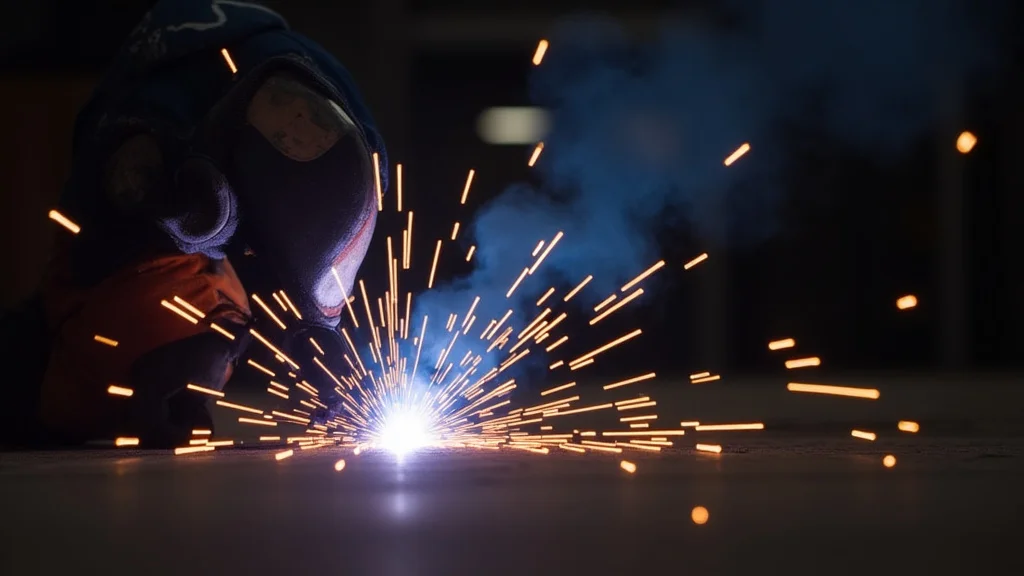
It’s a common frustration: you’re in the middle of a weld, and suddenly, your stick welder stops working. This is a big hurdle for anyone starting out. But don’t worry!
It’s usually a simple fix, and we’ll walk you through it step-by-step. Get ready to get your welder back up and running quickly. We’ll cover what to look for and how to solve it easily.
Key Takeaways
- You’ll learn the most common reasons a stick welder stops mid-weld.
- We will explain how to check your power supply and connections.
- You will discover how electrode angle and travel speed affect your weld.
- We will cover how to troubleshoot electrode issues.
- You’ll find out how to handle amperage and duty cycle problems.
- We will show you how to maintain your stick welder.
Why Your Stick Welder Might Stop Mid-Weld
When your stick welder decides to quit halfway through a weld, it can be really annoying. This problem, often summarized by the phrase Stick Welder Stopping Mid-Weld? Fix Fast, pops up a lot for people who are new to welding.
It’s not usually a sign of a broken machine, but rather something simple that got overlooked. Think of it like a car sputtering – it’s often a quick fix, not a major engine overhaul.
There are several reasons this happens. Some are about how you’re welding, some are about the equipment, and others are about the materials you’re using. We’re going to break down each of these reasons so you can pinpoint the exact cause and get back to welding smoothly.
Common Causes and How to Address Them
Let’s get into the nitty-gritty of why your welder might be giving you trouble and what you can do about it.
Power Supply Issues
The most basic reason a welder stops is that it’s not getting enough power. This can happen in a few ways.
Check Your Outlet and Extension Cords
Make sure your welder is plugged into the right kind of outlet. For most stick welders, you’ll need a 20-amp or 30-amp circuit. If you’re using an extension cord, it needs to be heavy-duty.
A thin, cheap cord can’t handle the electrical load, and the welder will lose power.
Always use the shortest extension cord possible. Longer cords mean more resistance, and less power gets to your welder. If you’re unsure about your wiring, it’s best to have an electrician check it out.
Circuit Breaker Tripping
Welders draw a lot of power. If your circuit breaker trips, it means the circuit is overloaded, which is a safety feature. Let the breaker cool down for a few minutes, then reset it.
If it trips again right away, you likely have a bigger power issue or your welder is drawing too much current for that circuit.
Electrode Problems
The electrode, or welding rod, is what actually melts and forms the weld. If there’s an issue with it, your weld will stop.
Wrong Electrode Type or Size
Different metals and welding positions need different types and sizes of electrodes. Using a rod that’s too big for your machine’s amperage or the thickness of your metal can cause it to stick or not melt properly, leading to an interrupted arc.
For example, a 1/8-inch 6013 rod needs a certain amperage range. If your welder is set too low, it won’t sustain the arc. If it’s too high, you might burn through the metal too quickly or have excessive spatter.
Moisture in Electrodes
Welding rods absorb moisture from the air. This moisture can cause arc instability, spatter, and eventually, the arc might extinguish. This is especially true for some types of flux-cored wires and certain stick electrodes.
If you suspect your rods are damp, you should dry them out. Many professional welders use a rod oven for this. For home use, you can try drying them in a kitchen oven set to a very low temperature (around 250-300°F or 120-150°C) for a couple of hours.
Make sure you know the recommended drying procedure for your specific rods.
Damaged Electrodes
If the flux coating on your electrode is chipped or damaged, it can lead to an inconsistent arc. The flux helps shield the weld pool and stabilize the arc. Damaged flux means a less stable weld.
Welding Technique Errors
How you hold the electrode and move it across the workpiece has a big impact on the weld. Simple technique mistakes can make your welder seem to stop working.
Incorrect Arc Length
The distance between the tip of the electrode and the metal you’re welding is called the arc length. If you hold the electrode too far away, the arc will be long and unstable, and it can easily go out. If you hold it too close, you might “stick” the electrode to the metal, which also stops the weld.
A good rule of thumb is to keep the arc length about the same as the diameter of the electrode you are using. For example, if you’re using a 1/8-inch electrode, your arc length should be about 1/8 inch.
Wrong Travel Speed
The speed at which you move the electrode along the joint is your travel speed. If you move too fast, the weld bead will be narrow and might not penetrate properly. If you move too slowly, you can end up with a wide, wavy bead and potential burn-through.
An inconsistent travel speed can make the arc seem to falter and stop. You want a smooth, steady pace that creates a consistent bead width and height.
Incorrect Electrode Angle
The angle at which you hold the electrode matters. Usually, you want to hold it at a slight drag angle, meaning the electrode is tilted slightly backward in the direction you are moving. This helps the flux and molten metal flow correctly.
Holding the electrode straight up and down or pushing it can lead to arc instability and an uneven weld. Experiment to find the angle that works best for your electrode and application.
Machine Settings and Limitations
Your welder itself has settings and limits that can cause it to stop.
Amperage Too Low
If the amperage setting on your welder is too low for the electrode you’re using or the metal thickness, the arc won’t be hot enough to melt the metal properly. It will be weak and may sputter out. You need enough amperage to maintain a steady arc and achieve good penetration.
Always check the recommended amperage range for your specific electrode size and type. This information is usually printed on the electrode packaging.
Duty Cycle Exceeded
This is a big one, especially for smaller, less expensive welders. Every welder has a “duty cycle.” This tells you how long you can weld continuously within a 10-minute period before the machine needs to cool down. For example, a 30% duty cycle at 100 amps means you can weld for 3 minutes out of every 10 minutes at 100 amps.
If you weld for too long without letting the welder cool, it will overheat and shut itself off to prevent damage. You’ll see an indicator light, often red, that shows it’s overheated. You just need to wait for it to cool down, which can take 5-15 minutes or more, depending on the machine and how hard you were working it.
Equipment Maintenance and Condition
Just like any tool, your stick welder needs to be kept in good shape.
Dirty or Loose Connections
Check all your connections: the power cord to the wall, the ground clamp to your workpiece, and the electrode holder to the welder’s cable. Loose or dirty connections create resistance, which can lead to power loss and a weak arc. Clean off any rust, dirt, or paint from the connection points.
Make sure all clamps are tightened down securely.
Damaged Cables or Electrode Holder
Inspect your welding cables and electrode holder for any signs of damage, like cuts, nicks, or fraying. Damaged cables can cause electrical shorts or poor conductivity, leading to arc problems. If a cable is damaged, it needs to be repaired or replaced by a professional.
Troubleshooting Steps: A Quick Guide
When your stick welder stops mid-weld, follow these steps to figure out the problem:
- Stop welding: Don’t force it.
- Check power: Is it plugged in securely? Is the breaker tripped?
- Inspect the electrode: Is it the right type and size? Is the flux okay? Is it damp?
- Examine your technique: Are you holding the right arc length and travel speed?
- Look at machine settings: Is the amperage correct? Have you been welding too long (duty cycle)?
- Check connections: Are the ground clamp and electrode holder tight and clean?
By systematically going through these points, you can often identify and fix the issue quickly.
Frequently Asked Questions
Question: Why does my stick welder arc break so easily?
Answer: An arc breaking easily can be due to several things, including an incorrect arc length, inconsistent travel speed, too low amperage, damp electrodes, or poor connections. Ensure your electrode is dry and your machine settings are appropriate for the rod you are using. Try to maintain a steady arc length, about the diameter of the electrode.
Question: My stick welder keeps shutting off. What’s wrong?
Answer: The most common reason a stick welder shuts off repeatedly is exceeding its duty cycle. If you’ve been welding for a while without a break, the machine might be overheating and engaging its thermal protection. Let it cool down completely before trying to weld again.
Also, check that the power supply is stable and not causing the welder to overload.
Question: Can using the wrong extension cord cause my stick welder to stop?
Answer: Absolutely. Using an extension cord that is too long or too thin (low gauge) will restrict the amount of electrical current reaching your welder. This can lead to an unstable arc that sputters and stops, or the welder may not even have enough power to start the arc effectively.
Always use a heavy-duty, short extension cord rated for the amperage your welder requires.
Question: I’m getting a lot of spatter, and the arc keeps going out. What should I do?
Answer: Excessive spatter and an intermittent arc often point to issues with the electrode or amperage. Make sure you are using the correct amperage setting for your electrode; too high or too low can cause spatter. Also, damp electrodes are a frequent cause of arc instability and increased spatter.
Try a new, dry electrode to see if that resolves the problem.
Question: How do I know if my stick welder needs professional repair?
Answer: If you’ve gone through all the basic troubleshooting steps and your welder still isn’t working correctly, it might need professional attention. Signs that suggest a repair is needed include burning smells, visible damage to internal components, or if the machine consistently fails to perform even after addressing common issues like power supply, electrodes, and technique. For safety and to avoid further damage, it’s best to consult a qualified repair technician.
Final Thoughts
When your stick welder stops mid-weld, remember it’s often a simple fix. You’ve learned that checking your power, electrode condition, welding technique, and machine settings are key. Paying attention to the details, like ensuring clean connections and respecting your welder’s duty cycle, makes a big difference.
Keep practicing these checks, and you’ll be able to troubleshoot most interruptions quickly. Get back to it and keep those welds strong!