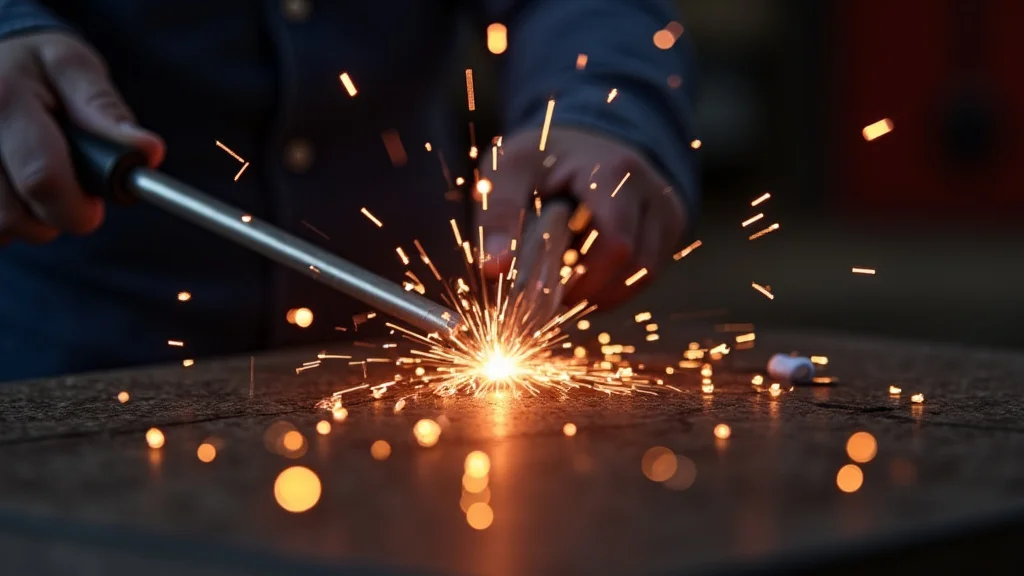
It can be frustrating when your welding rod sticks to the metal. This is a common problem for people just starting with a stick welder. It makes it hard to get a good weld and can feel like a big puzzle.
But don’t worry, fixing this is much simpler than it seems. We’ll walk through it step-by-step. Let’s make sure your rod keeps moving so you can get welding.
Key Takeaways
- Understand why your stick welder rod might be sticking.
- Learn how to adjust amperage to prevent sticking.
- Discover the importance of proper electrode angle and movement.
- Identify how metal type affects rod sticking.
- Recognize how arc length plays a role in avoiding stick.
- Find out how to handle damp electrodes.
Why Does My Stick Welder Rod Keep Sticking?
The Basics of Rod Sticking
When you’re learning to stick weld, one of the most common issues you’ll run into is the welding rod sticking to your workpiece. This is often called “arc-out” or “freezing.” It happens when the rod makes contact with the metal and doesn’t melt away properly, instead fusing itself to the surface. This can be discouraging, making it feel like you’re not making progress.
But this problem has simple causes and even simpler solutions. Knowing why it happens is the first step to stopping it.
Common Causes Explained
Several things can make your stick welder rod sticking. Think of it like trying to draw with a crayon that’s too soft or too hard. If your settings aren’t right, or if you’re not holding the rod correctly, it won’t melt the way it should.
The electricity from the welder needs to be just right to melt the rod and the metal together smoothly. If the power is too low, the rod won’t melt fast enough. If you’re moving too slowly or holding the rod at a bad angle, it can also get stuck.
Amperage: The Power Setting
The amperage setting on your stick welder is like the temperature on an oven. Too low, and things don’t cook properly. Too high, and they burn too fast.
For stick welding, amperage controls how hot your arc is. If your amperage is too low for the type of electrode you’re using, the rod won’t melt efficiently. It will start to stick to the metal because it’s not getting hot enough to flow.
This is one of the most frequent reasons beginners experience rod sticking. Always check the recommended amperage range for your specific welding rods.
Electrode Type and Size Matters
Not all welding rods are the same. They come in different sizes and are made for different types of metal and welding positions. A thicker rod often needs more amperage than a thinner one.
If you’re using a rod that’s too small for the amperage you’re set to, it might burn up too fast and get stuck. If the rod is too large for the amperage, it might not melt enough and can stick. Also, different electrode coatings have different melting characteristics.
For instance, E6010 rods are known for a “digging” arc, while E6013 rods have a softer, more forgiving arc that is less prone to sticking.
Metal Thickness
The metal you are welding on also plays a part. If you are welding on very thin metal, a high amperage setting can melt through the metal quickly, and the rod can stick to the edges of the hole. Conversely, if you are welding on very thick metal, you might need to increase your amperage to ensure the rod melts properly and fuses with the metal.
When learning, it’s often easier to start with medium-thickness steel, like about 1/8 inch or thicker.
Your Welding Angle
The way you hold the welding rod is important. You want to hold it at a slight angle, usually about 10-15 degrees, in the direction you are moving. This is called “pushing” the rod for some electrodes or “dragging” for others, depending on the electrode type.
If you hold the rod straight up and down, or at a backward angle, it can cause the molten metal to flow back onto the rod tip, causing it to stick. Maintaining a consistent, slight angle helps the arc burn cleanly and the rod to melt smoothly.
Travel Speed
How fast you move the welding rod along the metal is called travel speed. If you move too slowly, the rod will deposit too much molten metal in one spot. This can build up and cause the rod to get stuck.
If you move too fast, you won’t deposit enough metal, and the arc might not be stable, which can also lead to sticking. Finding the right balance is key. You want to see a steady, even bead of molten metal forming as you move.
Arc Length
The distance between the tip of your welding rod and the metal surface is the arc length. The ideal arc length is usually about the diameter of the welding rod. If you hold the arc too short, the rod will get too close to the metal and can stick.
If the arc is too long, the arc becomes unstable, you get a lot of spatter, and the weld quality suffers. A consistent, correct arc length is crucial for preventing sticking and creating a good weld. Think of it as keeping the right distance between a pencil and paper to draw a smooth line.
Moisture in Electrodes
Welding electrodes, especially certain types, can absorb moisture from the air. This moisture can cause problems when you try to weld. It can lead to a less stable arc, more spatter, and can even cause the electrode to stick more easily.
If you suspect your electrodes might be damp, they often need to be dried out in a special oven called a rod oven. For most general-purpose rods like E6013, storing them in a dry place is usually enough to keep them in good condition.
Simple Troubleshoot: Fixing Stick Welder Rod Sticking? Simple Troubleshoot
Troubleshooting Steps
Let’s break down how to fix your stick welder rod sticking. This is where we put what we’ve learned into action.
Step 1: Check Your Amperage
This is the very first thing to look at. Is your amperage set correctly for the rod and the metal thickness? Most welding rods have a recommended amperage range printed on the box or on the rod itself.
If you are experiencing sticking, try increasing the amperage slightly, perhaps by 5-10 amps, and see if that helps. For thinner metals, you might need to lower it, but sticking usually points to too low amperage. Experiment a little within the recommended range.
Step 2: Adjust Your Electrode Angle and Movement
Make sure you’re holding the rod at a slight angle, pushing it in the direction you’re welding. Try to maintain a steady, consistent angle. Also, focus on your travel speed.
If you think you’re moving too slowly, speed up a little. If you feel like you’re moving too fast, slow down. The goal is to create a consistent bead of molten metal.
Practice making straight lines and circles to get a feel for the right speed and angle.
Step 3: Control Your Arc Length
Be mindful of how far the rod tip is from the metal. Try to keep it at roughly the diameter of the rod. If you notice the rod is touching the metal, pull it back slightly to re-establish the arc.
Listen to the sound of the arc; it should be a steady crackle. If it becomes loud and spattery, your arc length is likely too long. If it’s sputtering and about to go out, it might be too short or your amperage is too low.
Step 4: Consider the Electrode Type
Are you using the right rod for the job? For beginners, E6013 is often recommended because it’s forgiving and less prone to sticking. If you’re using a rod like E6010 or E6011, which are “all-position” rods and require a faster travel speed, you might find them trickier to use initially.
If you’re struggling, switch to an E6013 for practice.
Step 5: Assess the Metal
If you’re welding very thin sheet metal, you might need to use a smaller diameter rod and a lower amperage. For thicker materials, ensure your amperage is high enough to get good penetration. If you’re welding on rusty or dirty metal, clean it first.
Dirt and rust can interfere with the arc and make the rod stick.
Step 6: Check for Electrode Moisture
If you’re welding in a humid environment or your electrodes have been open for a long time, moisture can be an issue. Try using a fresh, dry set of electrodes. If you have a rod oven, use it to ensure your rods are properly dried.
This is especially important for cellulosic rods like E6010.
Practice Makes Perfect
The most important thing is to practice. Grab some scrap metal and just try welding. Don’t worry too much about perfection at first.
Focus on keeping the rod moving, maintaining a consistent arc length, and using the right angle. Each time you weld, you’ll get a better feel for the machine and the process. Remember that Stick Welder Rod Sticking?
Simple Troubleshoot is a learning curve, and every welder goes through it.
Frequently Asked Questions
Question: What is the most common reason for a stick welder rod to stick?
Answer: The most common reason is amperage set too low for the welding rod and metal thickness being used.
Question: Should I push or drag the welding rod?
Answer: It depends on the type of electrode. E6013 is often dragged, while E6010/E6011 are typically pushed. Check the electrode packaging for recommendations.
Question: How can I tell if my welding arc length is correct?
Answer: Aim for an arc length about the diameter of the welding rod. Listen for a steady crackling sound and watch for minimal spatter.
Question: What should I do if I’m welding thin metal and the rod keeps sticking?
Answer: Try reducing your amperage and using a thinner diameter electrode. Ensure your travel speed is not too slow.
Question: Is it okay to use welding rods that have been in an open container for a while?
Answer: It’s best to use fresh, dry electrodes. If they’ve been exposed to humidity, they might cause more sticking and other welding issues. Consider drying them or using a new pack.
Final Thoughts
Getting your stick welder rod to stop sticking is achievable with a few simple adjustments. It often comes down to getting your amperage right for the rod you’re using and the metal you’re welding. Also, pay attention to how you hold the rod and how fast you move it.
Keeping a consistent angle and a steady travel speed is key. Don’t forget to keep the arc length just right – not too close, not too far. These basic steps make a big difference.
With a little practice and by checking these common issues, you’ll be welding smoothly in no time. Keep at it; you’ve got this!